
(free version) APOCALPYTARIAN ACCELERATIONISM
we are those who must build our nests during the eclipse

(Howdy. These articles cover a mixture of philosophical, cultural and religious themes from the leading edge of the overlapping transformational, developmental, and regenerative networks — the so-called Liminal Web. The paid version gets earlier release, bonus articles and, most importantly, an audio performance read by the author. That can be handy for long ones like this piece. Many of the topics are by request including this long-promised redux of the Apocalyptarian presentation…)
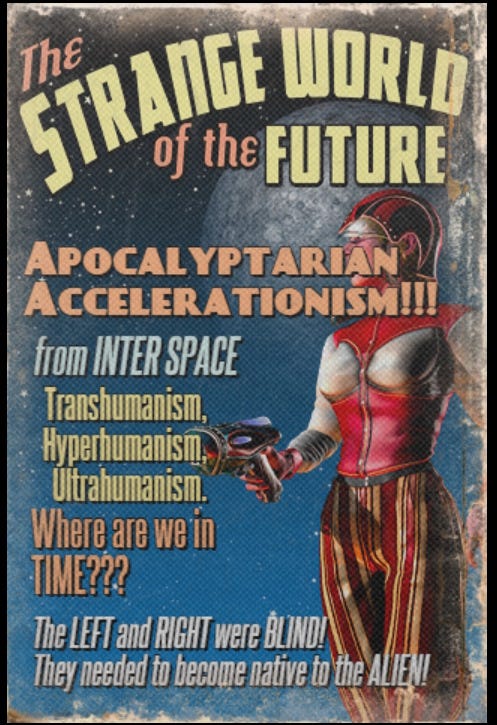
WEIRD TALES are no longer just a luxury item for artists, mystics, and science-fiction nerds. I love the speculative strangeness of imaginative futurism but this is not about me. Our whole world is living forward into an uncanny moment. Somehow, we have got to get serious about uncanniness.
This was the spirit that led me to say YES when the philosopher Cadell Last asked me to co-host (with the hyperhumanist Carl Hayden Smith) a month-long, January 2026 inquiry on The Philosophy Portal platform.
Our topic was Apocalyptic Accelerationism and its potential “hyperhumanist” solutions. Fancy words. Maybe they need to be fancy because they are probing the subtle & complex shapes that describe how weird our world is becoming.
For the course, I prepared some “rants” to highlight different facets of the unsettling transition that our current civilization is zooming toward, into, & through. Since we did not have time to get to all of those (and since not all of you were able to attend the course), I promised to present these mini-talks online.
That’s what this article is...
I. ON ACCELERATIONISM
Hyperhumanist apocalyptarian accelerationism. That is a long mouthful-o-words. It is the ostensible topic of this course. What do these terms mean?
Hyperhumanism is a way of talking about a humane alternative to transhumanism. Significant historical and technological transformations are obviously taking place in our world, but there is no need to imagine that our transformation is merely about cyborgs, digital consciousness, and genetic life extension. There are many archaic potentials and fully human mutations that might lurk down more decent, beautiful, and organically complex future pathways. In many profound ways, we do not even yet know what a human being IS or can DO.
Apocalyptarianism is my own term. It describes our need to recognize and adapt to the increase of cosmic weirdness in the “time between worlds.” Radical changes are occurring. The metacrisis is both doom and opportunity. The general population's vibe is anxious, discombulated, and we recognize something important in the image of the apocalypse. That sense of radical change, perplexity, and in-betweenness is becoming the dominant characteristic of our times.
Okay, now that those two are out of the way — what is accelerationism?
This refers to a set of philosophical attitudes that not only take historical acceleration seriously, but also suspect that we should lean into it. This attitude emerges in the contradiction between the sense that our civilization is deeply stuck and also that things are changing faster than ever.
The tension between these broadly shared contradictory feelings leads some folks to imagine that the solution might be to start “pushing the river.” Maybe go faster? Maybe take the risk of destabilizing rather than restabilizing? Maybe encourage the unpredictable changes, ride the new technology, and let the existing world order crumble under its own weight?
Accelerationism.
Interestingly, a so-called “left” and “right” version of this philosophy has emerged.
There is a Leftist fantasy in which accelerating the current technological, economic, and cultural trends may overwhelm the adaptive power of capitalism and force its mutation into its own opposite -- a planetary luxury communism in which the Market is automated, and the humans are left to pursue art, science, solidarity, and pleasure.
There is also a Right-wing fantasy in which more oil, more AI, more corruption, more anxiety, and derealization could accelerate the final breakdown of godless democratic liberalism, allowing us to reorganize into pseudo-traditionalist, oligarchic, ethno-states that cosplay as the pure, strong, pyramid-shaped empires of yore.
These are the two main positions (see Cadell’s articles) that have colonized the discourse on accelerationism.
They both sound idealistic, risky, perhaps even desperate. Yet there is also something beautiful in the courage to take the risk. And, after all, many parts of Nature and Mind behave like (what we used to call) Chinese Finger-traps. The key to release is often counterintuitive, and sometimes the only way out is... further in. I am trying to appreciate these strategies because I instinctively do not trust them.
I suspect both the Right and Left accelerationists of being hasty, narrow, and insufficiently interested in real complexity. Their plans to overcome modernity strike me as just more of what modernity does so well, i.e., capturing and neutralizing revolutionary energy by splitting the memetic space into “two popular sides” whose complementary attempts to correct the system end up simply updating the status quo.
The System (sic) is tricky. Adaptable. Metastable. Fuck Capitalism t-shirts are now available for purchase! Next to the anti-Communism merch. Both were made in the same warehouse by the same slaves, employees, robots, etc.
That flexibility makes it pretty hard to fight. It has weaknesses (topic of another essay), but anything that shows up as polarization and suggests “doing more of the same to correct the System” is probably part of its deep self-protection and self-regeneration.
Is another kind of accelerationism possible?
Can we go faster, double down, and mutate in ways that exceed the self-securing dialectic of the modernist economy? A strategy that unfolds the destiny and potential of a truly human transhumanity? One that is more sane, ecological, nuanced, and potent at the same time? Yes, I think so.
But do not let that seduce you toward optimism.
Apocalyptarian adaptation requires a deeper despair. An integration of the Tragic. A grieving process. Let your heart break. Decompose and recycle your hope. In the meantime, however, I do believe in an orthogonal accelerationism. A better accelerationism that moves perpendicular to the two dominant versions.
Other things are possible.
Suppose you wanted to actually accelerate beyond liberal democracy to its far shore? Does that mean you try to break the system, or that you should extend the range and variety of liberality and democracy? If you really believed that you could transform the current system by pushing it forward, then maybe we need to make it easier for more and more people to vote. More machines, mail-in ballots, and voting reform experiments. Amplify and extend the power of collective decisions until it mutates.
Alternatively, suppose we want to accelerate beyond the logic of capitalism. Shouldn’t we add more and more things into the market? Put aside communist fantasies and start quantifying all kinds of labor and resources? Turn everything into work and numbers? Multiply the number of metrics for market success beyond GDP? Put even more things (e.g., infrastructure and environmentalism) under the Pentagon budget?
You can hear in these two examples that there are forms of Left and Right accelerationism that do not correspond to the mood, assumptions, and actions of the people conventionally associated with those movements. My sense is that both sides are simply forms of the self-protection of the dominant system, UNLESS they start to think (and feel) more clearly about what an accelerated extension of the “stasis quo” might actually look like. Not a petulant regression informed by pre-existing attitudes but a real mutation based on an open-minded furtherance of the characteristics of the system that feels stuck.
The cognitive scientist John Vervaeke used to talk a lot about reciprocal narrowing. Two different ways for a dynamic coupling system to operate. They can mutually delude, stagnate, and collapse each other in a pattern that resembles addiction. Or they can cooperatively expand, integrate, and stabilize. A constructive or destructive cascade. This difference, which we might call healthy vs. unhealthy, is not foregrounded in standard discussions of accelerationism.
There is a perpendicular direction. At one end is the stupid war between Left and Right in a way that endlessly reinforces the system they both oppose while constantly risking regression and devastation. The other end is an unknown expansion of the current systemic principles in a way that might actually mutate or reverse its qualities.
And it emerges from the cracks of the Real.
But where do we start?
II. ON METHODOLOGIES
Carl (my co-host/co-teacher) gave a great presentation last week (i.e., in January) on “hyperhuman methods.” These are science-infused practices that aim to modify the context of our perception in ways that promote a richer mode of being human. For me, these are part of the ongoing wealth of psychotechnologies that constitute humanity’s spiritual attempt to refine, unfold, or transcend its existential condition.
In dancing with Carl & Cadell, I want to highlight three qualities that help to define the subset of psychotechnologies that is pertinent to the idea of a hyperhumanist, apocalyptarian acceleration into the near future of our weirding planet.
The practices we are looking at here are characterized by
(1) ecology
(2) integration, and
(3) community.
ECOLOGY is our basic context. As a constraint on psychotechnologies, it points toward practices that are specifically involved with, and evolved within, a realm. A life-world. This is an interactive space of complex symbiotic systems to which we must adapt and for which we must provide regenerative and transformative service.
Ecological psychotechnologies are adaptive. In practice, this requires the intentional re-orientation of human bodies, sensory organs, and multiple intelligences toward the richness, immersive nuances, and organic patterning styles that provide the living source and background of our partially understood human complexity.
Carl’s emphasis on practices to decompress our optical and psychological field of vision (you had to be there) provides a way of intensifying our adaptive contact with the elements that make up an ecological surrounding. This facilitates an increased reciprocity between our internalized patterns and those in which we are embedded. In addition to Carl’s exercises, we might also put into this category the various breathing methods and yogic strategies that emerged for people such as Wim Hof and Leonard Orr through sustained, intense, elemental immersion.
We can also look at studies demonstrating decreased sensory acuity among children raised in the manipulative simplicity of urban and media-driven environments (in contrast to those raised in the tricky, multivarious, and complex sensory perceptions of a rich wilderness landscape). That insidious collapse of human capacity within impoverished and oversimplied artificial communication spaces highlights the need for psychotechnologies that enrich our interiority through adaptation to Nature’s nuances.
Both Carl’s project of unfolding latent human capacity and my work on being more indigenous to our quasi-apocalyptic epoch involve the deliberate amplification of attentional practices that adapt our neuropsychology more thoroughly to our rich, regenerative, and complex environmental conditions. That’s the ecology aspect.
By INTEGRATION, I mean that we can analyze virtually all classical and novel psychotechnologies as ways of integrating (or synchronizing, resonantly coupling, or enhancing the collaboration of) subjectively active informational subsystems.
These inner “subsystems,” which are both psychological and biological, can be analysed from different directions. We have many different modules or streams of experience that can be brought into “conscious struggle.” The simultaneous or oscillating activation of pertinent multiple contexts of sensemaking and behavior. This double experience, or charged parallax, is an important key to evoking a more generalized and comprehensive way of being. A more full-spectrum self with a more reliable sense of human being-ness.
Of course, we do not necessarily have to think about our practices in these terms. The languages of simple flow, divine grace, or even effortless release are very useful, but we also have this interesting option to analyze and engineer the dynamics of these practices as an essentially integrative or intra-psychic phenomenon.
And the last thing I had in mind was COMMUNITY. The psychotechologies being explored in this course are not practices that are self-applied by totally isolated individuals. We do these things with each other.
Okay, that’s the end of the reflective preamble on methodologies. My intent here was to appreciate and amplify Carl’s presentation by highlighting three examples of the porosity or permeability at the root of these particular psychotechnologies. Adaptive permeability to ecosystems. Interior intentional permeability between intelligence subsystems. And the mutuality between selves & others that is both deeply true of all beings and pragmatically necessary for the accelerating time period we are now entering.
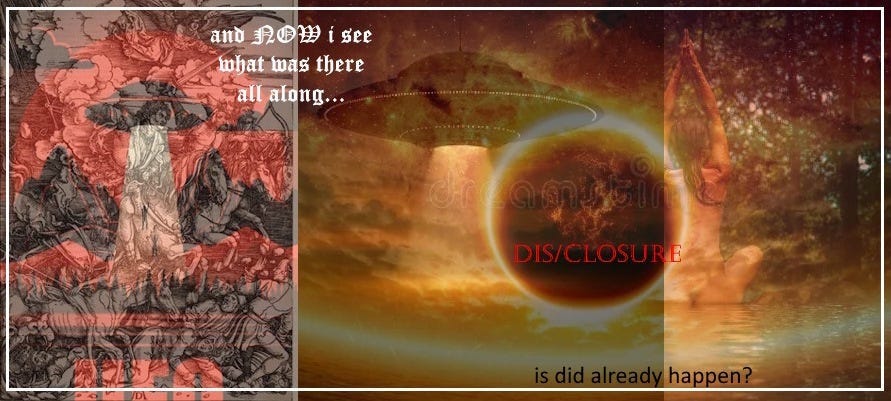
III. THE AGE OF DIS/CLOSURE
Anybody with philosophical friends, or too much time on their hands, already knows that Apocalypse is not just a condition of breakdown, suffering, and radical dissolution. It is a word akin to revelation or disclosure. The making seen of the unseen. The coming to light of what has been hidden since the Beginning of the System. Night things come forth to be inspected by the light of day.
It is probably no coincidence (assuming that coincidence, or its opposite, can even exist) that contemporary social, political, and scientific efforts to get military and corporate bureaucracies to reveal whatever they might know about UAPS, UFOs, anomalous entities, unusual technologies, etc., are widely referred to as the Disclosure Movement.
Whatever we personally think about “aliens,” and the strange fascination they exert over certain types of people, we can nevertheless view this phenomenon as a notable example of the Spirit of an Age of Disclosure.
Although folklore cultures and shamanic lineages speak about unusual transhuman, elemental, and quasi-material entities, our rapidly unravelling modern epoch has sought to simplify, clarify, and amplify our relationship to certain aspects of the natural world by presenting a strong skeptical challenge to the ancient evidence of mythic community beliefs and unusual states of consciousness.
Good. Yet those efforts have not eradicated these common human experiences or their enduring psychosocial effects. Ongoing accounts of such phenomena have transformed into the lore of extraterrestrial visitors and strange ultra-material crafts. This has been relentlessly mocked and radically marginalized by modern authorities.
That is, until recently.
Mainstream universities, the US government, many Pentagon insiders, as well as voices from the bureaucratic and military establishments of many other countries, have started saying, or gotten louder about saying: these things are real. Or rather, they have started saying that there is “something going on” that they “do not understand.”
Some regular and significant portion of these encounters, both via technology and by individuals whom we otherwise treat as highly credible witnesses, cannot be readily explained as misidentified objects, secret government projects, or as the secret projects of other governments. This is now a more-or-less official position held by government and military authorities around the world.
Strange.
Think about the intensification of ambiguity involved in the current situation. The material, reductionist, control-oriented, top-down authorities are now sending STRONGLY MIXED MESSAGES concerning nonhuman intelligences, anomalous entities, and the vast peculiarity of the cosmos.
And the more closely we examine these mixed messages, the more mixed they become. The more convinced we get that neither hoax, nor hallucination, nor extraterrestrial visitors can quite explain the sheer weirdness of what is being constantly reported and constantly half-documented.
This could be an ideological affection or a psyop. It could be new real entities, archaic entities, or something that exceeds those kinds of categories. A whole mandala of possibilities, clusters around the (?!) ambiguity that is being collectively “disclosed.”
Ontological flooding in the Age of Disclosure.
The revealing of previously hidden or discredited layers of reality in a way that does not simply increase knowledge but constantly offers a double-impression, yes and a no, mixed messages & growing weirdness. The UFO enthusiast hopes for new facts that shift hidden knowledge toward the surface. What they get is the amplification of parallax and plurality.
The same thing has happened in our physics. We want a solid new view of the universe. Instead, we got Einsteinian bending of space-time and quantum indeterminacy. New facts were revealed by theory and measurement. They had been hidden in matter since the beginning, but now they were disclosed. Yet it did not settle and clarify the situation. It made things feel weirder, more slippery, incomplete. Are there 11 dimensions now? Is retrocausality in the mix? Just examine the overall trend of these disclosures at the heart of our current sense of physical reality.
We dug up the ground and found giant mycelial organisms. We set up computers and found endless fractal complexity. We peered into cells and discovered self-organizing, elfin cartoon cities rather than a simple mechanism. The more we looked, the weirder it got. This is characteristic of the reality being disclosed.
To become more indigenous to this world, we must take certain risks in terms of emotionally allowing ourselves to feel that we are not in Kansas anymore. We are in Oz.
We are unmoored, yet we cannot live without secure attachment to reality. So we must work towards secure attachment with the revealed realm itself. Start to become friends with this more complicated and indeterminate quality of the world. And one of the first steps in this adaptation may be to mentally grasp it. See it. Name it.
To observe the pattern of what has been happening to our idea of reality as we have “disclosed” more about reality, to expect that pattern to continue, and to conceive it as an intrinsic property of our environment.
IV. MY DEAR WATSON
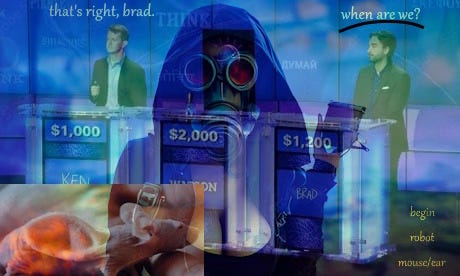
In 2011, an IBM computer named “Watson” defeated human contestants on the popular American TV game show Jeopardy! It was an interesting moment. Halfway between robots beating the Chess masters and robots beating the Go masters. Of course, we might quibble about how autonomous Watson actually was and which features allowed for its success. We also do not want to naively attribute superhuman consciousness to computational devices. But with all the objective caveats in place, it was intensely interesting to me because I saw it happen live on television.
I was astonished.
Bizarrely, what astonished me was how NOT astonished I was.
I kept saying to myself:
“Hey, you idiot, a robot just went on a human game show and defeated the contestants! Wake up! This is science fiction become reality. This would have seemed like an mind-shatteringly extraordinary event to any author in the 1940s but you are barely registering that it happened. Why aren’t you overwhelmed? Where is your shock? Where is your remaking of your assumptions about the world?
-My Internal Monologue, 2011.
I started to reflect. After all, if the news I consumed was to be believed, we had found organisms on space rocks. We grew a human ear on the back of a rat. Cars were driving themselves. These are intensely astonishing in comparison to the entire history of human civilization and life on Earth. But are we even registering them?
Or, more to the point:
Are we doing what it takes to make them real for ourselves? One of my heroes, the iconoclastic philosopher Georges Gurdjieff, said that a real human life consists of what he called “personal experiences, personally experienced.” Well, okay. We are having personal experiences about our moment in history, but are we personally experiencing them? Are we, to put it bluntly, actually assimilating any of this shit?
I would suggest that, in general, we lack any visceral, instinctive, or deep sense of what historical period we occupy. Our gut feelings about reality are intensely important but dangerously out-of-date because we do not perform any intentional praxis designed to get our subconscious sensibilities up to date.
We consume massive amounts of news. We hear about discoveries. We are hopeful, anxious, judgmental, and curious, but nonetheless, we do not do a lot of deep processing. Ask yourself, when was the last time you took a walk (or a sauna, or a sensory deprivation float, or a seated meditation) devoted to spending just one hour reviewing everything that has changed already in your lifetime?
When did you last do any deliberate emotional, mental, somatic, or imaginative work whose purpose was to chew up and digest the signs of where we are in the Great Timeline? Are you even trying to feel out what kind of world this is?
What kind of world is now?
It’s weird. We agree about its weirdness, but that agreement is just the beginning. We have to start adapting to the weirdness. We have to take it on board. We have to do to it what our body does to physical food. A mixture of conscious chewing and subconscious digestion that begins with the wish, the hunger, the appetite to make “strange update information” into a living part of ourselves.
We did not have to worry much about this in the past.
Once upon a time, many generations could live and die in roughly the same background circumstances. That meant that they could get very good at those circumstances over the course of dozens of generational cycles. They could deepen into their local ecosystem one grandparent at a time. They could slowly develop profoundly simple but powerful heuristics for meaningful thriving and the activation of complementary human capacities within a mostly unchanging biological and cultural environment.
Over many cycles, the immigrants (and everyone and everything is ultimately an immigrant) can go from invasive to native species — just by living embedded in the multi-directional organic complexity of a region. That’s the ancient normal way to do it. But today we do not have that luxury of time.
Our environmental, technological, and social world changes multiple times significantly within a single human lifespan. Although much stays the same, many things have been radically altered. And the rate of this alteration is increasing.
When my grandparents (Ruth, Rupert, Albert & Edna) were born (not that long ago), there were about 1.7 billion living humans. Now there are 8 billion. When they grew up, there were no nuclear weapons, and no person had ever gone off the Earth. You could not surgically and hormonally alter your gender. There was no genetic engineering. We did not all have plastic in our blood. No one had heard about giant underground mycelial organisms, lasers, holograms, Gobekli Tepe, DNA, the United Nations, fascism, probiotics, or color television. All that and more is taken for granted, just a few years later, as part of the world in which I am embedded. Thus, I cannot significantly rely on the inherited wisdom of my grandparents (and their grandparents) to guide my life.
And, conversely, if I wish to offer something useful to my children (and their children), it cannot be strategies for adapting to a reality that is no longer present. Instead, all that I can sanely offer are principles for rapid adaptation to transformative circumstances.
The people of tomorrow and the day after will not be fundamentally served by skills and attitudes that allow them to live, by inherited logic, in a consistent and normal world. Instead, climate change, mass migration, technological revolutions, and the mutating informational and cultural landscapes mean that they probably have to adapt multiple times to diverse environments.
To thrive in such an unsettled world requires that a body of knowledge (a lore, a dharma) be cultivated now by intelligent, well-meaning subcultural networks that can emphasize accelerated indigenization.
Whether we are talking about global climate refugees, national immigration problems, or just how families and individuals learn to live in a new city, new country, new era, or maybe even offworld, the question is the same:
What does it take to become native faster?
One dimension of the problem involves studying and embracing the existing populations that we call indigenous, native, or aboriginal. They may preserve lore, behavior, and attitudes that can communicate nuances concerning their ancestors' successful adaptive strategies. However, that is just the beginning. There is much they do not know about the emerging world. And in either case, we must (unlike our ancestors) become much more intentional, trans-ethnic, and fast-paced about our adaptive processes.
What are some ways we can already begin to think about this?
Consider what it takes for a sapient neuro-organism (which I have heard is also called a “person”) to get functionally familiar with a new region? Suppose you move to a new town. Just looking at maps is pretty meagre. Picking up a few glimpses on your way between home and work, or school, is probably not enough to start developing an internal root system connected to this environment. In most cases, you will have to get out, in your body, and explore. Exploring is different than “going somewhere.” It involves getting lost and finding your way back. It is experiential and experimental. It shares this with the attempt to garden local plant species. Open-ended, locality-based, behavioral interventions that elicit “cognitive hunger” (biological interest in map making).
Another strategy you might use for deepening your connection to a new region might be temporal contrast. This is super-straightforward. Watching how “the same thing” changes in the region over time. Go down to the river each season. Make observations of the same tree, lake, bees, foxes, otters, slime, etc., as they shift from one season to the next over several years. This was a tremendous source of wisdom for our ancestors. What they gained from generations of casual observations, you might be able to accelerate with more frequent, more targeted, and more intentional inspections. The importance is not the “knowing” but the “noticing” since most of our neurobiological adaptation is subconscious. Just keep giving it the relevant data.
Another ultra-simple strategy is to forage. You have to touch, smell, and nibble the things that live in this new place. Not excessively, subtly. Not so that you put yourself at risk of toxic compounds. Very small touches, sniffs, and tastes are a way of directly transmitting local “ecological” bio-informational architecture into your own “neurocultural” bio-informational architecture.
(Note: Just had intense deja vu about writing this. Writers don’t usually mention that, but who knows, it could be important.)
Other simple strategies could involve making some kind of inner contact with the symbols, lore, and dreams of the people who have already adapted (or tried to adapt to) this new place. You must finds it boundaries. Walk its edges. Figure out who its pre-existing shamanic edgewalkers are. And let its bacteria colonize, and negotiate with, your existing bacteria.
These are a few of the simplest and most accessible, non-esoteric ways of beginning to think about accelerated indigenization. We no longer adapt to a single persistent normal world. We have to quickly and progressively get better at adaptively normalising an abnormal world.
We are talking about going beyond the idea of securing & returning to the forms of previous human adaptation. Instead, we are thinking about the attitudes, skills, and behaviors that optimize the enfolding of new places, knowledge, life & circumstances into our human purposes. Facetiously, we could call this a hybrid of colonizer and colonized wisdom. In reality, it is the recognition of the need to accelerate ancient adaptive processes to rapidly unfolding radical transformations.
And if we cannot do that kind of acceleration, then we will likely drift toward a fast-adapting system that ignores human experience and purposes.
V. HIGH-TRUST SUBNETWORKS
Human beings have periodically felt epochs of deeply unsettling strangeness. This is not a purely contemporary situation.
Imagine our prehistoric ancestors. They often discovered very successful adaptations allowing them to live for centuries or millennia in the same way. When the background conditions of their life were relatively stable, the chieftains and the matriarchs (technocrats and sociocrats) could act as effective custodians of collective decision-making and resource distribution. Older people automatically became useful elders because “merely surviving longer,” within that particular stable situation, produces verbal and nonverbal intelligence that can help fine-tune the flourishing of subsequent generations facing the same situation.
To receive cultural inheritance and maintain it is a truly sacred thing. But when the background conditions change, when there is ecological instability, because of climatic disruption, or chunks of rock falling from the sky, or because humans’ harvesting and pollution practices have caught up with us, or when there is technological shift, or encounters with new kinds of beings, or new balances in the ecosystem — then the collective unconscious of the tribe begins losing confidence in chieftains and matriachs who are specialized for a system that can no longer be relied upon.
It is at this point that it turns out to be prescient and pragmatic to have mature weirdness workers in your small-world network. Hunter S. Thompson famously said, “When the going gets weird, the weird turn pro.” These shamanoids, witches, or weirdos, who have been haunting the edge of the village, tracking non-rational patterns, and showing up to do therapeutic or developmental or ritual tasks, suddenly have a political significance. Their status, practice, and compulsion to be half-inside and half-outside the paradigm of the village now becomes an important social asset.
The human collective needs to gamble on actions and sensemaking styles that do not feel normal because they have to respond to a world that no longer feels normal. The cultural field reaches out for figures who blow their minds, who speak in strange ways, who activate trances, who disregard boundaries, who commune with unconscious forces, etc. Maybe you get a good one, maybe you get a bad one. It is clear either way that the conventional rule of sober managers is not responding to the scale and tempo of the actual drivers of the problem.
So that’s an ancient normal thing. And we can follow it through recorded history both in periods of collapse and in phases of apocaplytarian vibes. The common story is that St. John, author of the Christian book of Revelation, anticipated the End in his lifetime. People were feeling apocalyptic back then.
There have been numerous periods where novelty or instability has caused people to feel like a great strangeness, an unearthly intensity, was bleeding through the cosmic veil and transfiguring worldly affairs.
In my old Stoa talk on Apocalyptarianism, I mentioned Gurdjieff’s idea of the Solioonensius. He mythologizes it as a cosmic pressure wave. It is created when massive interstellar bodies get too close to each other (like when someone gets too near on the sidewalk). A subtle tension is created. It flows through space and ripples through planetary biospheres. A normative healthy planet would be prepared for this ingression of strange energy and use it to become more urgent and active in its evolutionary spirituality. An unprepared civilization, however, simply feels overwhelmed by an unspecified revolutionary urge. The sense of ambient acceleration becomes war, political madness, and pointless attacks on the inherited processes that regulate our common life.
If you saw Christopher Nolan’s film Oppenheimer, you might remember that while the “philosopher-physicists” are waking in the night, electrically agitated by deep glimpses into the ethereal infrastructure of galactic and subatomic realities, the rest of the planet is responding to the same cultural atmosphere with war, genocide, and regression. So we can think about apocalyptarian phases coming and going through history. Yet, these vibes seem to have become more frequent, perhaps more intense, during the last few centuries and decades. It is as if we were accelerating toward a meta-stable condition of perpetual acceleration that somehow settles upon the Unsettling.
It is so common that we can begin to organize around it.
In a manner reminiscent of the origin story of the 7th Adventist Church. Their founder proclaimed a mathematical Biblical prediction pointing to the End of the World. People gathered at his farm to await the Great Moment. They were already feeling it. The prediction resonated with their latent mood. But the world did not end. The leader said: Oh, I got the calculations wrong! Math is hard. Come back next year and the world will definitely end at that moment. Next year, even more people showed up. The year after, even more.
Today, it is simply an ongoing religion.
A rationalist cannot believe this stupidity! The continued failure of evidence is taken as proof? Yet it is very interesting to observe that (a) people needed to hear their apocalyptic feeling validated, and (b) they collectively wanted to use that feeling as a catalyst for forming new communities and a new way of life.
They build around their apocalyptic vibe. Our question then is how to do something similar but smarter.
How do we settle into the unsettledness? Like the doubter who gains a new confidence by doubting his own doubt, can we grow a capacity to live sensibly in a world of peculiarity and omni-skepticism? Can we, for example, teach our children to be uncontracted, emotionally responsive, fully human, existentially participatory, in a world where even video images and voice calls from loved ones can be easily faked?
We have to live into a world where massive distrust is needed. The apocalypse of trust. Anything can appear to be anything else. The hackability of the human heart, mind, and body is everywhere on display. But we have to actually LIVE in that world.
We must evolve communities that practice the particular kinds of balance required to love, rejoice, work, suffer, philosophize, build, innovate, feed, and luxuriate meaningfully in a realm that initially feels under a vast shadow of radical risk. We are those who must build our nests during the eclipse.
And yet, as mentioned above, we are not the first to feel the apocalpytarian vibes. So we must learn from the successes and failures of previous communities that responded to the waves of weirdness.
The 20th century was full of cults and communes. These were the predecessors of today’s “intentional communities.” They sought to escape, transform, and prepare themselves against a backdrop of radical peculiarity and dangerous modernism. A few thrived. A few are lingering. Many failed catastrophically or were gradually reabsorbed into the mainstream culture.
Why did most of them fail to operate as dynamic imaginal cells of the new civilization?
Some broke down as a result of dogmatic personality structures blind to important aspects of practical or community reality. That is a common risk, given that a shared belief or charismatic leader is often the prime catalyst for new communities. Understandable but inherently unstable. It tends to drive out the more complex, interesting, and sensitive participants. There is a deep inquiry here. How do you embrace divergence and social complexity while maintaining enough of a membrane to keep internal consistency of efforts and preserve the difference between the community and the general culture? My suspicion is that we need analytic tools and individuals who can operate as inter-community researchers, helpers, and stabilizers. Who can, perhaps, even make assimilable to community authorities the valid intelligence possessed by those who leave or get ejected.
Another common problem in intentional communities is that people go too fast in their desire to be sincere, trustworthy, trusting, loving, devoted, cooperative, positive, non-reactive, etc. Too many people jump too quickly to demonstrate that they are virtuously “all in.” That sidelines a lot of your human complexity and intelligent nuances. It can also hinder the slower organic growth of authentic trust and virtue.
I am a strong believer in what I call high-trust subnetworks. Within the broader communities, the meta-network, you have to be guided by intrigue and affinity; figure out who you enjoy, and with whom you can functionally cooperate in a relatively unforced manner. This slower organic growth, incremental, often indirect, and possibly peculiar, deepens peer friendship and allows the naturalization of relationships. It does not proceed by an idealized leap into trusting the community but rather it honors misgivings with a good conscience. It reaches like tree roots moving in the dark. Many iterations of risk, doubt, and evaluation perform a task that superficial waves of willingness cannot accomplish.
In principle, we are all on the same team, but the people with whom you can survive on a space station are very few. The people you can have in your intimacy bubble are very few. Friendship is serious. It has to be vetted bit by bit.
So the message of this section is that our Age of Weirdness is preceded by many ancient waves of weirdness that have much to teach us. One of those lessons is to make haste slowly — learning to form real connections and unfold rich forms of trust that enfold our diversity, doubt, and individual self-regulation processes.
VI. EVALUATION AS PRAXIS
When I translate Nietzsche, I like to treat Übermensch as ultrahuman — instead of Superman or Overman. I have noticed that most readers of Nietzsche forget that a “mensch” is a real stand-up guy. Humane. Characterized by a grounded human decency. So while there are definitely alien and inhuman elements to the ultrahuman, let us also remember that it also points to a “fully-human transhuman.”
This is a figure that goes beyond our humanist notions about the nature and limits of a human being, but also lives the transformative edge of what it means to be more completely “human” and more completely a “being.”
There is a full spectrum human condition that is typically truncated or narrowed by our educational systems, families, media, politics, economics, etc. We might imagine the richer existential condition as being naturalism in the form of humanism. Being as fully human/e as the jaguar is a jaguar. That is a humanism that I could respect.
Is humanism too anthropomorphic? We get hung up on that possibility and rightly want to make sure that we are not imagining that all intelligences are like unto ourselves. Yet our form is not isolated. Our characteristics are inherited from the rest of Nature. Who walks upright on two legs, has complicated language, self-awareness, extended childhoods, intergenerational wisdom transmission, and can build tools to make other tools? Crows.
Most of what we call anthropomorphic could also be called crow-opo-morphic. It is actually quite anthropocentric to believe these attributes are anthropomorphic. They are more general than we often assume. I say that we should think of the ultrahuman as an entangled concept that weaves its futuristic novelty together with deep humanism and deeper ecology. Remember that Nietzsche’s Zarathustra tells us to be “true to the Earth and true to the Body,” as we cultivate beings who can rehumanize on the far side of the Abyss.
Yet there are other elements to this vision.
We must not forget that the ultrahuman is also a response to the meaning crisis. The value problem. Nihilism in the post-secular age. Nietzsche gives us a prophecy about the Apocalypse of Values that may describe our current unfolding era. This is no simple problem. It cannot be solved simply by denouncing relativists and choosing to believe in transcendental virtues. Nihilism is not the absence of passionately asserted beliefs. Rather, it is the insidious erosion of our values and beliefs from within.
Nihilism was hidden in our idealism. We culturally and religiously aspired toward values that created the nullification, neutralization, and regression of our capacity for meaning-making. Widespread social collapse into trivial and self-indulgent ideals is the result of our higher ideals.
It is not that we fail to revere. It is worse than that. The things we teach each other to revere have been denuded of organic reverentiality. Our cultural farming practices have rendered the soil infertile. That soil is named “God,” and “truth,” and “goodness,” and “worthiness,” and “peace,” etc.
So we enter the time of what Nietzsche calls the Last Man. A slow awakening to the presence of a missing quality whose absence was created by our religions, philosophies, sciences, and social reform movements. The self-ruination of the highest values. Here we find terminal humans who inhabit the cul-de-sac of the meaning crisis.
An apocalpytarian mood begins to saturate this twilight condition as we notice, slowly or quickly, that our values are not producing spiritual, biological, or social valuableness. Our wealth of information is not informing us. Students use AI to write essays that professors use AI to mark. The forms remain, but they are hollowed out and ineffective as sources of meaningful human living.
In response, Nietzsche advocates for new, daring, experimental philosophers. He calls upon them to study the strange, unpalatable, organic, and even immoral, roots of how effective value is generated. In addition to studying the sources of value-experience, he asks them to volunteer for the speculative task of bringing about the ultrahuman — the fully human, pre-human, & post-human being who lives so deeply (and well) into nihilism that he/she/they is mutated into a new kind of evaluator.
This is a being for whom radical disbelief and maximal meaning can co-exist.
Perhaps we might view them as sources of surplus value rather than seekers. The symbolic plane of socially-mediated meaningfulness is no longer viable as a solution to the problem. An entirely new inner and interpersonal scheme for value-production is needed. If the Last Men narrow the meaningfulness of all meanings, then the Ultrahuman must secure a meaningfulness beyond all meanings.
So when we think about the apocalyptarian idea, remember that one significant feature of this mega-liminal & multi-liminal realm is the value problem. And when we think about acceleration, think about what it means to go further into the structures that we associate with the collapse of meaning. And when we think about the hyperhuman, remember that it also involves a deep shift in how we generate, amplify, and promulgate the experience of vauableness.
VII. THE CTHULHUCENE
Last week (you had to be there), Carl played a clip of director James Cameron saying that we already live in a science-fiction world. That is another way of saying that we must be apocalpytarian. We must grapple with living in a world whose revelation of the principles of reality creates living conditions that feel post-normal.
The great pioneer of post-normal science fiction was the amateur American pulp fiction author H.P. Lovecraft. He invented or clarified the genre of Cosmic Horror. This guy was a strange and sensitive dreamer who idolized the writers of the Gothic era and believed that Modernity contained the seeds of its own destruction.
He was initially quite reactionary, racist, and authoritarian, but by the time of his death, he had become a weird kind of socialist. However, it was not just the ethnic diversity and economic privations of contemporary civilization that bothered him. There was a more fundamental point of worry and intrigue. A portal was being opened by the interdisciplinary convergence of modern sciences.
New machines, new analyses, and new research were allowing consilience between the leading edges of many disciplines. This was producing a more accurate map of cosmos, history & psyche which, Lovecraft was sure, would reveal the radically anti-modern patterns that constitute reality itself. As soon as our researches stray into the vast vagaries of deep time, down to the fathomless bottoms of the ocean, out into the dark voids beyond the solar system, and into the depraved architectures that hold sway within the cellular kingdom, then we encounter truly post-modern patterning. Disorienting scales and aesthetics that are imaginatively epitomized in Lovecraft’s new pantheon of monsters, such as the many-tentacled, chimeric, and aeons-old Cthulhu.
The philosopher Donna Haraway coined the term Cthulhucene for the already emerging epoch that exceeds the Anthropocene and the dominion of capital. A kind of hypohumanist situation that re-places humans into Nature’s omnidirectional, trans-rational, multi-species interconnectivity. This can sometimes feel utterly terrifying and dark to our controlling, modern, left-brain Apollonian intellect.
Like putting your hand into a fertile pile of compost, there is an initial sense of grotesquerie and inhumanity involved in making contact with nonlinear, organic, adaptive, and symbiotic processes. They lurk and writhe. So perhaps we can use the term Cthulhucene as another way to name the apocalyptarian world into which we are sliding — faster and faster.
There are two major failure modes for that acceleration:
One failure is to pretend it isn’t happening. Blindly press onward with business as usual. Pretend that human operations are fine as they are. Or that they can readily course correct to avoid radical changes.
This failure mode ignores our rapid trajectory. It does not grapple with the externalities of our dominant processes. Hypermodernity is a term used by some metamodernists to describe a false postmodernism in which modernity perpetuates and insulates itself by its own typical strategies to performatively critique and correct itself.
The other failure mode is a naive resignation and withdrawal. An environmentalism so unimaginative that it can only think of scaling back, doing less, reducing the human, rather than figuring out how to play our responsible role in the stabilization and transformation of the biosphere through aligned noospheric actions.
Agency, not passivity, is needed. However, we must understand, as our sciences and our ancestors understood, that agency depends on proper balances. The solution to this alignment problem is not action in contrast to inaction. Nor is it inaction compared to action. It must exceed the dichotomy that describes our stuckness.
The Taoist notion of Wu-wei is not about surrender or non-action. It is about the kind of action that blurs the line between spontaneous activity & goal-oriented activity. This characterizes the entire creative spectrum of flow in which we are always adjusting the degree of control or release appropriate to the flourishing of a shared context.
How do you ride a horse? You hold on tight -- but not too tight.
The actual structure of thinking is nondual (opposites cannot be thought without at least the minimal contextualization of their reciprocal concept), but it takes practice to access a natural hybrid mentality.
Problematic or short-term thinking proposes a basic choice. Taoist thinking seeks a relatively optimal balance of reciprocal qualities in any embedded, complex, and participatory context.
So to adapt to the Cthulhucene (an age that discloses trans-rational organic complexity in all directions), we need to get better at regenerating flow states — including the emotional and intellectual transcendence of conventional opposites.
The oscillation, ambiguity, and paradoxical structures that characterize our mystics, our great physicists and philosophers, and our weirdest artists (all the things that are built from a simultaneous yes-and-no) have something to tell us about how we must think, feel, and live in the Time that initially seems like a time between Times. A time of Liminality.
To wrestle with Cthulhu, you must be able to move in two directions at once.
VIII. ORDEALOLOGY
Most of us are probably familiar with Wim Hof. He is not just an idiosyncratic exponent of ancient yogic techniques of breath and heat. He is an example of an adaptive process. He believes that his “scientifically verified” high-powered immune system, ability to tolerate thermal extremes, general sense of energy and meaningfulness, and even his particular breathing methods were revealed to him from elemental powers.
The ice taught him!
Whatever the problems of his personality, cultural brand, and the danger of doing the exercises wrongly (don’t induce oxygen deprivation under water!), he strikes me as an example of an archaic process. Our ancestors evolved under all kinds of extreme conditions without the luxury of heating, air conditioning, antibiotics, or sophisticated clothing. Nomadic people had to adapt both psychologically and physiologically, often quickly, to diverse territories. Their direct exposure to environmental intensities could sometimes trigger a super-adaptive response of accelerated bio-psychological indigenization. Changes in breathing, immune reaction, and cellular activity were among the results of appropriate ordeals.
This is very important for both the apocalyptarian and hyperhuman arguments. It suggests that immersion, exposure, and certain forms of voluntary distress may be critical for both adapting to worlds & eliciting capacities.
Some of you may have read my article on Ordealology (it’s on Substack, but Metapsychosis reprinted it with different creepy art). It is about the need to figure out how to suffer better.
We know that ongoing mid-level background stress is gradually debilitating. We also know that growth, healing, and even emotional self-regulation require periodic, voluntary, intense stress. That is what athletes do. That is what people explore in BDSM. That is a cold plunge or a difficult conversation or an undertaking that builds willpower. It breaks your superficial dopamine automation and activates other parts of the brain, which release hormones to adaptively organize body and soul.
We all suffer, mostly uselessly, much of the time. Either because we do things unintelligently or because we are addicted to our endlessly repeating moral reactions and uncertainties. All that suffering ought to be diminished. But there are other options and they turn out to be a necessary component of adaptation-to-worlds.
Our disposition toward suffering must change. Much should be released, much must be accepted, and some must be chosen deliberately. We have to lean into our suffering in order to activate its catalytic adaptive power.
But what is suffering? It is a contradiction.
It is a force pushing against another force. A desire thwarted. The parallax of two interpretations, or two perspectives, arguing over the same stimulus. We do not like this mutual electrocution of our importances. Our brains have a function called cognitive dissonance, whereby we often “gap out” to avoid any strong internal contradiction.
To activate the distress that adapts to the world as it is (and is becoming), we have to invite the right phenomenological contradictions, and we have to be able to experience, rather than thwart, the intensities of our affective and cognitive dissonance.
Here are three ways this applies to the overlap of apocalyptarianism, hyperhumanism, and accelerationism:
1. To become what Carl calls “hyperhuman,” we have to acknowledge and then work to integrate the many contradictions and disparate drives that exist within the human being. Animals are very coordinated. A supple leopard looks lovely leaping up into a tree with a dead gazelle in her jaws, but we complicated upright apes are so full of internal disagreements that we have to do special labor to regain our naturalness.
This work is possible. We can become a more integrated complexity rather than a disintegrated complication.
That requires our attention to occupy the space between our different modes, drives, and sensemaking options. We have to become friends with our struggles. We must develop an appetite for our double-mindedness, dichotomies, and dilemmas. That means we must be willing to suffer, to hold longer and with more curiosity, in the friction that we instinctively want to escape from. In this way, we build our unique beingness — coming again to be natural in our access to the fuller range of human capacities for insight, action, and self-transformation.
2. We are in an age of ambiguity, uncertainty, polarization, and push-button deception. We cannot believe anything without its opposite being trumpeted. The machine gets paid when you get outraged or covetous, so even our precious cul-de-sacs of self-justifying information do not protect us from the flood of conflicting signals. We must become better inhabitants of this self-disagreeing realm. Integrative meta-philosophies and post-postmodern communities can help. However, we also need to be workers, warriors, and citizens who deal with this endless yes/and/no world. To succeed within unending juxtapositions and contradictions requires us to artfully, intelligently, and as bravely as we can, lean into the tension. There is no place of escape from the information conflicts, but there is a possibility of transmuting the conflict itself. A necessary skill for living a worthwhile life within an apocalyptarian realm.
3) Coming back to the Wim Hoffery of it all, we must find ways to expose ourselves to the intensities of our environments. Our geospheric, biospheric, and noospheric environments. Hot and cold, yes. Different biomes, yes. We co-evolve with complex systems that can provoke our adaptive, indigeneizing chemistry through smart voluntary distresses. And the same is true in culture.
We need to burn ourselves sometimes with ambiguous and disorienting art, ideas, and science. It is not just about being informed and “open.” It is specifically about an adaptive effect produced by certain intensities. The cultural equivalent of freezing ice might be material that is strongly peculiar, uncertain, offensive, opaque, disorienting, etc.
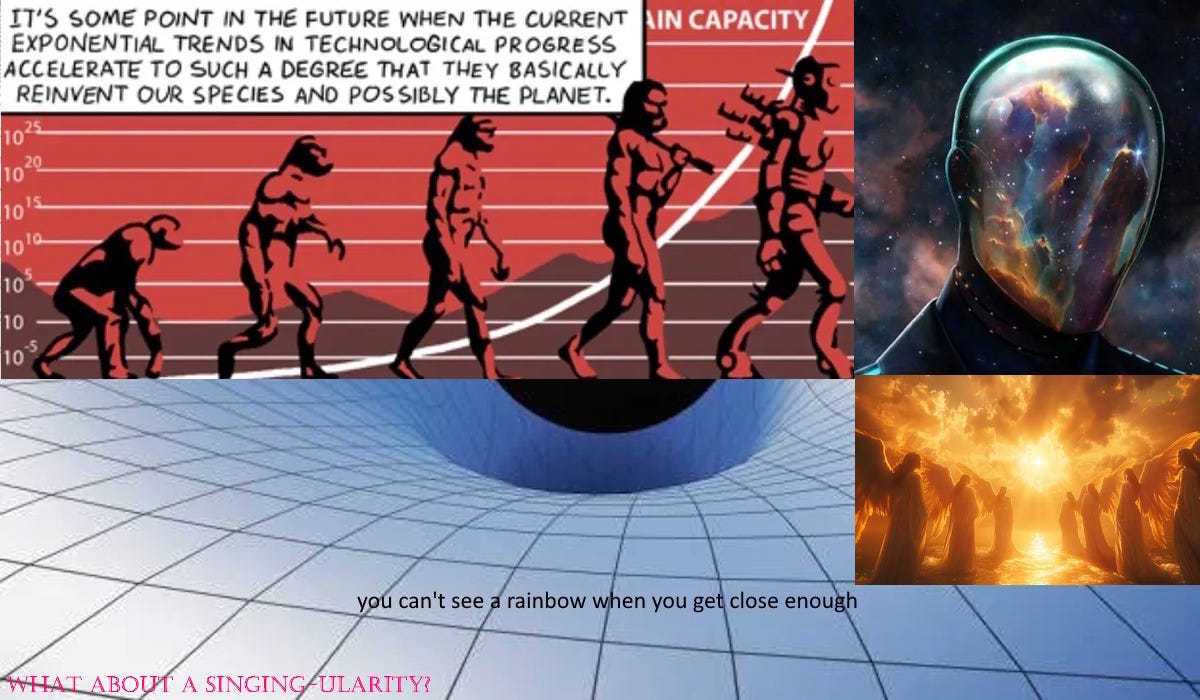
IX. THE SINGINGULARITY IS NEAR
Another way to talk about the Metacrisis is to say that our surprises are converging.
Humanity’s shamans have always been diplomats. After the ice age (when we all started to expand and re-contact each other), it was the people with high “trait openness” who could negotiate with alien and foreign rival tribes. But these same tendencies allowed them to negotiate between Nature and Village. Human and non-human. Earth and heaven. Intelligence and quasi-intelligences.
Today, we have a new task for these negotiators. Something like new non-human quasi-intelligences are springing up through our fingers. We call them AI. These are weird systems. They occupy a weird space for human beings. Clearly, they are not those self-conscious superintelligent computers that 20th-century science fiction imagined, but they are also something more-or-different than just fancy calculators.
They pass most of our “Turing tests.” That means they can trick people into treating them as people. And we debate the degree to which their information-organizing strategies are similar to our own. Mostly, we have been using them to create averaged predictions based on digitized social and verbal data. An impressively competent conversation machine. Beyond that, we do not know how far they can go. Is there a computational ceiling that imposes a real limit on this innovation? Or are even greater computational mutations coming?
Right now, our big problem is that we will misuse these tools. Replace the wrong kinds of labor and thinking. Put these systems into roles for which they are not ready to be safely competent. Use them to hack each other. Reduce our average cognitive capacity. Disrupt markets and governance with no real plan for the fallout. Give new asymmetrical power to oligarchic families, nation-states, political parties, intelligence services, corporations, and organized religions.
This already apocalyptic scenario is playing out against a few weak calls for a slowdown or legal limits upon children’s access to these systems. We ain’t seen nothin’ yet. The problem is a much weirder one. All these concerns are in the immediate foreground, but we have to think beyond AI. Not just to AGI (the idea that we can generalize the flexibility of these systems), and not just to ASI (the idea that they could massively outperform human intelligence in certain ways). That is already coming, yes. But all of that has to be framed as part of a more general technological trend toward innovative disruption & convergence.
Disruption and convergence?
Yes. That’s what I said.
Think about the smartphone. It is not just a phone. It is a phone combined with a television, combined with a radio, combined with a compass, a day planner, a gaming system, a flashlight... you get the idea. “Techne” (as Heidegger called it) produces convergent tools. So the looming technological singularity that we need to be thinking about is not just the initial one. Not just a computational system that can outthink us and evolve itself. That is not even terribly novel. Society and Nature are already computational systems that can surprise us and evolve themselves. Instead, we need to be already feeling forward toward the surprising convergence of multiple disruptive innovation trends.
The all-singing, all-dancing hypersingularity. A singingularity.
Take a Large Language Model (or perhaps an entire ecosystem of interactive Large Language Models). Train them not just on language, but also on art, entertainment, logic, science, real-time information from bodies, brains, emotions, ecologies, and whatever. That is already unfolding. But so is quantum computing. What happens when we combine them? Then what happens when we combine that with circuitry grown as synthetic flesh? And what happens when we combine that with Michael Levin’s experiments to electrically reorganise societies of biological and physical agents at lower levels of the evolutionary stack?
Combine that with the production of new meta-materials that have never existed on this planet before. Add the capacity to genetically alter the capacities and deep structure of all organisms (including ourselves). Add neuro-digital interfaces that might not only control people but also produce people might feel that such control is actually their own natural decision. Then run it all on the new Wolfram-style physics of irreducible nonlinear patterns in a physics of multidimensional hyperspace.
Just to name a few confluent tributaries to the great river ahead.
Mind-bending technological integrations are not speculative prophecy for the far future. It is a near-future event that is already organizing itself. We cannot merely focus on the weird leading edge of a single technology. We have to anticipate unpredictable mergers & cross-fertilizations of many technological leading edges — each of which is potentially radically disruptive on its own. Altogether, that is a world into which we are accelerating.
We may already be feeling the pre-ripples. The strangeness of something on the other side of what we call AI. Something we cannot quite imagine but which is not very far away. A device-or-entity not revealed to us by particular expertise in any particular domain of technology because it is being born across those domains. We cannot see it yet, but perhaps we can already feel it. Like the dangerous and miraculous content of a pit into which we have started sliding…
So keep all that approaching weirdness in mind. That is the singularity we need to be oriented towards. But at the same time, let us also think about humanizing our systems. The full, functional, and phenomenological content of human beings is still in play. We are still part of the equation. However, that is not as straightforward as it might have seemed to the citizens of modern civilization.
You are not automatically already the real human being who can show up in the emerging world of post-cybernetic entities. We have to educate and inter-educate our emotions, minds, bodies, etc. We have to keep subjectivity and intersubjectivity evolving in play through our art, ideas, and practices. I call this HGI. Human general intelligence. Gregg Henriques calls it “Mind 4.”
We need to stop resting on the idea of being already completely human and start becoming capable of humanizing — in the best sense of that term. What is it to humanize? It is not as simple as the message of neo-liberal humanists who want us to be rational, nice, and international. The inhuman, pre-human, trans-human, and the inherent multiplicity and antagonism that constitute the human are all in play as part of that great humanization effort that Teilhard de Chardin tracked and prophesied.
Humanization occurs with the help of the plants and animals, the subconscious, the liminal, the nonlinear, the occult, the transcendent, the shadow, etc.
There are two things I want to highlight in that regard. They both revolve around what I would call the noospheric clarification and reiteration of the biosphere. Or maybe just “putting the hand into the glove.”
Think about this:
Doctors around the world recommend “forest bathing.” It is good for your body and nervous system to spend time immersed in the deep woods. The effect is not just from the lush aesthetics and airborne chemicals. It is also the particular electrical fields that are restorative to your cells. These fields combat mania and depression and, as the neuroecologists are now demonstrating, increase the power of your attention. In contrast to these benign effects, people are uselessly suffering unhealthy effects from the total amount of electrical simulation provided by the fields of our digital devices. They are jangly on the nervous system. Regardless of how much we might mentally enjoy gaming, coding, scrolling, or chatting, our bodies contract during these activities. We lose coherence and suppleness. It is sub-optimal self-regulation.
But these fields are just electromagnetic wiggles moving at particular speeds. Wiggles can be slowed down or sped up using constructive or destructive interference. So it is reasonable to think that we could build our devices in a way that modifies their output of electrical waves to cause those waves to approximate the frequencies found in the deep forest. A simple technical challenge.
This is an example of thinking about constraining or reorganizing our technological & informational world according to the patterning styles that emerge in the ecological realm — in ways that would vivify spiritual organisms like us. We could do things like that in all domains of production. We could naturalize our noospheric products.
Put the hand into the glove.
Many very common possibilities exist for patterning the noosphere in alignment with the most successful aspects of the biosphere. Biomimicry. Paintings of nature. Science documentaries. Put psychoactive fungus into our brains. Sit immersed in a wild environment and absorb the impressions. Put sensors on the feet of migrating birds and drifting oceans. Utilize parametric architecture. Think like Buckminster Fuller or Christopher Alexander or Sepp Holzer. Go to the parks for annual “re-creation” holidays. Etc. The seed of a really interesting idea exists in all these straightforward practices.
It is the idea that naturalness is not a pre-existing fixed amount.
Nature is not a quantity that must be carefully conserved against the incursions of artificial human action. It is a quality that we can, like the permaculturalists, work to generate through our interventions in the patterns around us. We are called to be agents and clarifiers of a pro-naturalism system. Collaborative generators, eliciters, and navigators who skew all kinds of configurations toward that ethically significant, aesthetically compelling, and biospherically inspired set of informational parameters that produce the human/nature hybrid quality that we call “naturalness.”
Take this kind of “purposeful cosmology” lightly. Yet it is possible to imagine that the basic parameters of the Cosmos might unintentionally slant across many random adaptations toward structures that create more integrated information, slowly stacking this capacity, getting better at getting better at it. A great many theorists hold such a view today. And imagine this unfolding clarity and capacity results in particular styles of configuration that express this telonomic and aesthetic drift. As biology learns from matter, the techno-cultural minds learn from biology, progressing step by step toward participatory, regenerative, multi-directional simplexity and coherence. We might as well call it naturalness.
An important feature of this unfolding is that each “step” has double functions. Each regime of informational organization across cosmic history has to be able to both walk and chew gum. That means they have to be able to expand their search space AND also constrain it. The Darwinian double move. We experiment and mutate, try new things, and expand our capacity. Yes. We also gain proficiency in clarifying naturalness and use that understanding to narrow and control the range of new capacities that are produced. Mutate & constrain.
We do this externally, by building technologies and gaining power over environments. Internally, we do this through art, dreaming, mysticism, imagination, soulmaking, and energetic direct engagement with the Spirit of the World. Together, these interior and exterior tasks help Gaia unfold the next phase of the naturalness project.
Our job is to externally and internally colonize the noosphere with the intelligence of the biosphere (put the hand in the glove) to help Her both root and flower more profoundly by elaborating technologies and ideas & equally by constraining them through more precise objective and subjective clarity about the qualities, ratios, effects and affects of ‘naturalness.’
That’s one example of a simultaneously immanent and transcendent (or “strong transcendence with pre-eminent immanence” as I sometimes like to say) story that puts our species to work along a trajectory of acceleration that enfolds techo-capitalism but prioritises sacred naturalism, shamanic functions, and service to the living system in which we and the other species are embedded. A vision that I call the Ecodrome. There are other stories we could tell. Take this as an example of using mythos to learn to live in the current epoch by reframing its disruptions as part of a complex order that requires our agency, our communion, and our responsibility.
Reframing disruptions.
This is the adaptive growth mindset that turns error into wisdom, shock into strength, and a fragmentary culture into a coherent civilization. We have a bounty of disruptions today that are ripe for enfoldment into a better narrative. For example, we have already destabilized several of the planetary boundary conditions for biospheric self-regulation. That is either an apocalyptic disaster or an apocalyptic opportunity.
If the radical changes to the ecology are potentially part of an appropriate radical shift, a mutation or a maturational phase for the organism that we call a biosphere (she is moving into her adulthood as a more internally mapped, technologically supplemented and seed-generating offworld sporation) then we are not just suffering a period of disruption, we have to get to work helping this to be the right kind of disruption.
The transhumanists and the conventional accelerationists are thinking about how to exploit the emerging disruption of our inherited common life. Hyperhumanists and Apocalyptarians should be thinking about a better, richer, more naturalistic way to harvest the same radical changes that are already underway.
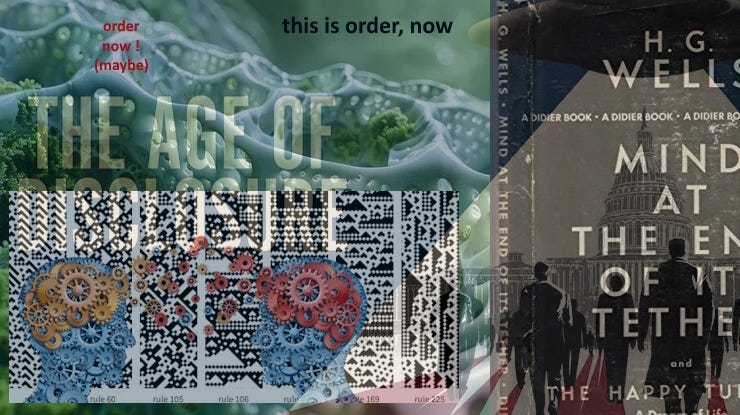
X. MIND AT THE END OF ITS TETHER
HG Wells, the science fiction pioneer who wrote War of the Worlds, The Invisible Man, The Time Machine, et al., also wrote a small, philosophical book just before he died. His last book. It was titled: Mind at the End of its Tether. In this curious volume, Mr. Wells announced that humanity was basically done.
We had, he believed, learned too much and seen too much. Done all the things that a species can do before exhausting itself, destroying itself, and getting replaced by another kind of intelligence.
It is easy to mock the fanciful ravings of our ancestors (who always seemed to think they were at the End of Time, and that science was finished in their generation), but something is interesting about this basic idea of the human project at the end of its tether.
In a way, we could be seeing the limit of what the “conscious waking-state rational left-brain self-serving individual” can do. This mind, the privileged agent of modern progress, the protagonist of Game A, has become exposed, challenged, undermined, and possibly exhausted by the very circumstances it created.
In the Age of Disclosure, many pre-existing truths about this dominant mind of ours come to light. We have used science, statistics, and reason to discover that our reasoning process depends upon emotion. Our psyche is deeply embodied. We do not operate as rational economic agents except when we have head injuries or are born as sociopaths. We have all sorts of cognitive and social biases. We are embedded in ideological systems of production and resource organisation that distort our thinking. We are limited in our amount of memory and processing speed, and the range of perspectives that we can take. We are not masters of the universe or pure captains of our fate. Although we should develop more capacity for reasoning, agency, willpower, and individual competence (it is wise to be good at those things), these qualities are ultimately limited vis-à-vis Reality. So if we want to thrive in a universe in which reason itself concludes that most patterns do not appear as patterned to our rational mind and senses, we must become better teammates with other forms of intelligence.
What other forms?
Notably, obviously, the collective, subconscious, computational, and ecological intelligences. Maybe aliens enter the mix. Maybe they don’t. Either way, we have to harness the capacity of other kinds of processors. If we do not get better at this, then the people who sense “the limit of the rational mind” will most likely start falling back upon their own irrationality. We already see many people imagining that nonsense and primitivism are cunning strategies for returning to greatness.
One of the battle cries of the global conservative resurgence of the 21st century has been a “return” to the gut instinct. That points to another kind of intelligence. Back when Stephen Colbert was funny, he called this Truthiness. A gut feeling that something should be true regardless of the facts. It is what Daniel Kahneman called System 1. High speed, very efficient, automatic thinking. Excellent at certain specialized tasks. Unfortunately, it is also riddled with predictable cognitive blind spots that make it easily hacked by marketers, machines, and belief systems.
Most guts are weak and untutored. Full of aspartame, high fructose corn syrup, processed wheat, addictive sucrose, plastic particles, estrogen, carcinogens, low-grade patriotism, and emotionalist dogma. Uneducated and unhealthy guts will probably not save us. We need other modes of intelligence, but they must be activated and explored by those with good education, strong prefrontal cortex abilities, and progressive humanist values. The irrationality of sensitive, educated people needs to outperform the irrationality of distressed, low-information citizens.
Beyond that education, though, we need other trans-conscious allies.
One is our computational ally. That means that we can use machines to work with patterns that cannot be detected at the speed and range of human consciousness. There seem to be patterns that are computationally irreducible. Complex enough that another complex system (like us) cannot compress them to the point that we can shortcut the process through algebra, geometry, or reasoning. So we need tools that can simply run these patterns vastly faster than us — and report back on what they do.
This is one way to make post-rationality workable.
Another way is to harness collective intelligence. We know about the madness of crowds, but under the right conditions, there is a wisdom of crowds. A mob, a voting base, a social media swarm, a programmed consumer demographic, a hypermediated generational sensibility, these are not necessarily intelligent. Lots of people can be dumb together. However, under particular arrangements, they can also be smarter than the smartest person in the group. This is the aspiration of democracy.
Real-world democracies do not have a great track record for harnessing this intelligence. We have a sense that something fair and shared is needed for our political field to thrive, but that “intersubjective vibe” has to be matched by inter-objective systems of collaboration and decision-making that operate with the same depth of intelligence. Too few of us take the possibility of smarter systems seriously, but top-down authoritarian control, egalitarian consensus, and majoritarian representation are all kinda dumb. Not to mention the corruption-incentivizing habit of organizing human labor under the self-servicing control of a small handful of commissioners, ministers, VPs, managers, or major shareholders. These are all recipes for limiting the amount of shared and integrated intelligence that the organization can express in the world. Smarter groups could be an intelligence that supplements HG Well’s idea of the exhausted “individual conscious mind.”
Another form of transrational intelligence is in our subconscious potential.
There is a whole ecosystem in there. Something partly self-like that operates when we are deeply asleep, distracted, or before our child selves even learned socialized thinking. This can be healthy or unhealthy. This can be smart or dumb. We have figures like artists, shamans, and intuitive scientists who suggest that our subconscious can get much smarter — but it needs to feed, grow, feel secure, get challenged, and get educated. We need to start getting better at using the “front personality” as a good assistant to the potential genius in the background.
Another ally is ecological intelligence. Humans are already doing amazing things to harness patterns and develop solutions found in the structures of the ecosystem. Trillions of interacting organisms with billions of years to explore have found many of the best-fit solutions. They have worked out how to solve multiple problems simultaneously in ways that make future problems less likely. We can study, harvest, and deploy many of these pre-existing solutions.
Just this morning I was thinking that I should get some of those fungal spores that break down plastics and toxins. What if I just put them in my garbage each week, so that they were deposited into the local dump? Imagine if we all did that. Humans today are not very good at recycling most of our industrial shit, but the radical mycologists (who are among the many groups working to decode and deploy biospheric solutions) suggest that fungi can do this far better than our machines and chemicals.
All this is to say that some of our emerging Weirdness is that the “normal mind” may be at the end of its tether. That will necessarily feel strange. Apocalyptic. It forces us to turn to trans-rational and trans-personal intelligences. Our shared visions of the near future, both utopian and dystopian, point to that fact. We will need healthy computational, ecological, subconscious, and collective allies if we are going to inhabit, handle, and thrive in the post-Apollonian realm.
XI. HUMANIST PLURALISM
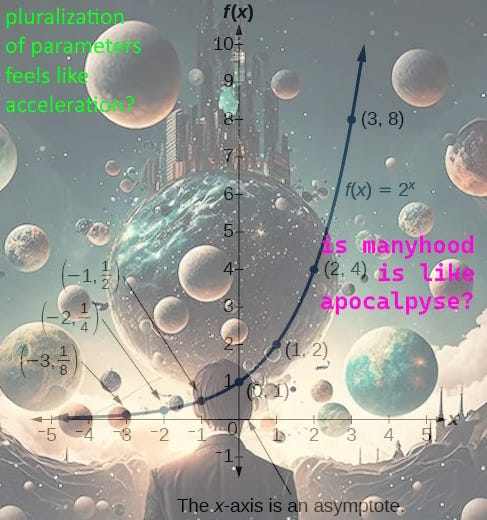
One of the things that creates or corresponds to accelerationism, to acceleration in general, is a trajectory that deviates from one metric into a multiplicity of metrics.
Think about the fins built onto the backs of racing cars. They exist because if you accelerate very fast, your vehicle will stop merely moving forward, and it will also start to move upward — off the surface of the Earth. Beyond a certain velocity, we require an additional set of variables to describe what is happening. Another dimension. The experience of acceleration is often described as an increase in the number of changes we need to track.
Anyone who went through “high school” is used to seeing graphs that feature a line that suddenly veers upward and vanishes! An exponential trajectory. We depict it as a variable accelerating off the graph into another unspecified framework. The simple combination of Descartes’s x and y axes is no longer adequate. A leap from bits to quantum bits. A geometric shift from squares to cubes. Not just a rate of increase but an additional intensity that disrupts the simplicity of our calculations by requiring an additional dimension of points at each step of the process.
It is almost as though the curve on the graph is passing out of the realm of Modernity’s single metrics of progress. Traversing toward a polymodern or metamodern domain that attempts to bring coherence to multiple, simultaneous, interacting metrics. In developmental studies, they talk about a shift from formal to post-formal cognition. In physics, there is a shift beyond Newtonian calculations into relativistic measurements and the multiple timelines of dynamically entangled variables.
Maybe our period of history feels like it is disrupted and accelerating because it has discovered, revealed, disclosed, that all of our moves are complicated by an additional plurality of interactive variables.
This is often how regressive traditionalists would express their sense of the apocalyptic realm. They are angry at the feeling of someone forcing the (“shoving it down their throats”) to take a whole bunch of additional factors into account. Consider all these extra things, or you cannot be full citizens in the new reality!
For example, binary descriptions of gender are exploded into a swarm of interactive fluid categories. Food isn’t just food anymore — it is a complicated set of ingredients that have histories, subtle effects, and ethical implications. Words do not just express your feelings, they also create realities for other people. And then you have to hear about it! It is exhausting. Why are environmental regulations getting in the way of my building project? Why is our tax money going to Africa? Why can’t I just believe realistic visual and audio footage? Or trust people who phone me and say they are from the bank?
A Doomsday of Pluralism.
The freak out is legitimate. Even very smart thinkers are overwhelmed and triggered by certain kinds of multi-contextual, juxtaposed, deconstructionist art, theory, and culture. Feels like it is taking over. Confusing everything. Devaluing all previous solutions for feeling natural and empowered. The conservative response is very straightforward.
Conversely, the liberal education system hints at the important power of pluralities but generally fails to cultivate a lot of emotionally and socially mature beings who can sanely work with this multidirectional space. It usually does not walk the talk.
So there are both Left and Right ways that fail to accelerate. Yet accelerate we must. And the richness of perception that comes from integrating more variables is extraordinary. I was told once that when Nirvana recorded its famous Nevermind album, the producer David Geffen threw out their main studio microphone. He replaced it with many tiny microphones placed all over the studio and on all the surfaces of the equipment. The overlap of the multiplicity produces a powerful richness that the single perceiver cannot capture.
Critics of modernist political economy deploy cognitive mechanisms of this same kind. They want to know why countries are predominantly using the single metric of GDP to evaluate national economies. We know for a fact that GDP can go up whilst almost everyone’s wealth, health, and meaning are going down. A single variable excludes much of what is needed to adaptively organize human beings in our world.
Why are we still so primitive as to think it makes sense that one person should “represent” each political region? Where is the organic decentralization that so many are prophesying? The general problem of contracted and centralized organization, with single metrics of progress, suddenly stands out to people who are learning to see in plural-vision. But it creates a kind of multilateral intensity that feels like we are zooming off the graph.
You reach for an object and find, instead, a swarm.
Metamodernism is, in some ways, a name for the attempt to bring humanising coherence to the reality of post-modern pluralism. To use synergy and tensegrity to connect many selves, perspectives, and nodes into effective, distributed, and organic systems. But we have to pass through the unsettling quality of acceleration.
We cannot put the genie back in the bottle. We cannot pretend that pluralism and multi-contextuality have not been disclosed. The revelation is manyhood is upon us.
An apocalypse of plurality.
That is a lot. Literally and figuratively. Almost a dozen probes into my take on the conjunction of accelerationism, hyperhumanism & apocalpytarianism that represent a naturalistic, developmental and flourishing line of flight that moves perpendicular to the reactionary and transhumanist versions of surviving the Metacrisis. Thanks again to Carl Hayden Smith for joining me in this inquiry and for Cadell Last’s encouragement and hosting at The Philosophy Portal.