Black Metamodernism
Having Skin in the Developmental Complexity Game

(To support this work, receive the author’s logical cadences & audio performances of these essays, get advanced and bonus articles, AND gain merit on the Way, become a paid subscriber. Also: enjoy. Or at least: suffer the right way. )
Black metamodernism??? That’s right. They said it couldn’t be done, but it turns out ‘they’ were racists. Or am I a racist? Maybe. Saying, “No!” is just a little too easy. And apparently, all the avowed non-racists & anti-racists are not preventing widespread cultural backsliding. Let us investigate together with daring minds, empathic hearts, serious levity, and an abundance of nuances.
Metamodernism (or perhaps metamodernity) is a name for the attempt to renormalize, rehumanize, and resacralize our complex, trans-cultural, deconstructed, and meta-reflective world of postmodernity. It is the most general form of post-postmodernism. It seeks to embrace, heal, AND transcend the patterns of contemporary society.
What does that mean? Well, it would have to restore real depth, subjectivity, faith, progress, and heartfelt intersubjectivity without failing to be pluralist, ecological, skeptical, contextual, and ironic. Complexity and meta-reflection are a way of life, but they need to develop in tandem with voluntary simplicity, conviviality, and decency.
The metamodern mind circulates between different historical and cognitive operating systems such as postmodernity, modernity, traditionality, & indigeneity. It leans toward a complex nonduality that no longer believes in limiting contradictions such as authenticity vs performativity or individual vs collective. It always only finds them entangled. So it lives that as Truth.
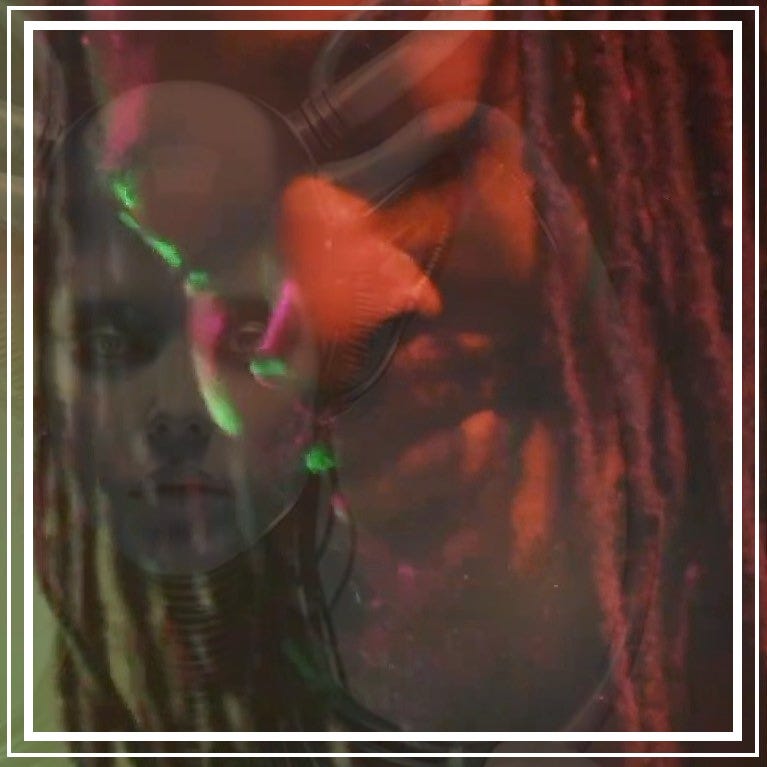
While my own association with these leading-edge weirdos is perhaps most appropriately labelled as “metamodern spirituality,” there are also many other active tentacles. Some of these tentacles are focused on critical philosophy and socio-political transformation. One of that “some of these” is Black Metamodernism. And the figure most closely associated with the term is probably the British post-Hegelian theorist, musician, and activist Germane Marvel (pictured below with a faintly superimposed face of an alien robot).
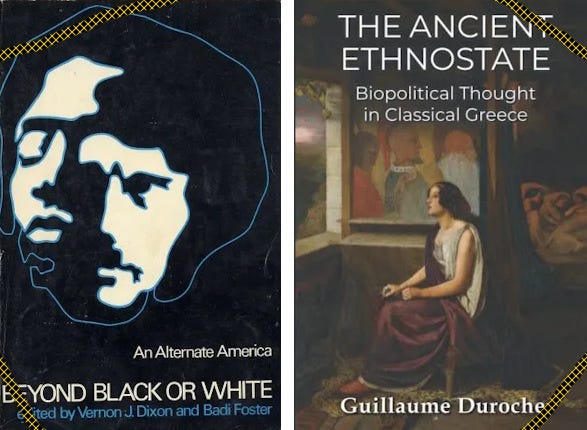
Another proponent of this framing is Brent Cooper. Together, they have been responsible for foregrounding the contributions of more diverse sociological ancestors of metamodernism and integrative thinking. In particular, the Black scholar Vernon Dixon’s diunital approach to both/and consciousness has been highlighted.
Germane has argued for the need to grow beyond mere dialectical oscillations (i.e., metamodernism as a back-and-forth consciousness) toward more stabilized synthetic positions that align with a grounded, humanist, and emancipatory politics. Black Metamodernists have also revalorized the wisdom of the global South (so frequently left out of East/West discourses), while proposing themselves as voices for a culturally embodied, multi-perspectival way of life with egalitarian socio-economic goals. And all this is envisioned within an endless ethos of actively resolving “cognitive dissonance” into coherent, unfolding, and complex emotions.
In other words: continual ongoing Black Liberation FOR EVERYBODY!
I am not an expert or a primary exponent of their work although I will borrow a few ideas from it. You should check it out directly. The reason I mention Black Metamodernism is because the haunting spectre of “race” is a useful jumping-off point for exploring real-world variations of current metamodern political sensibilities.
I. Metamodern Politics
Is Black Metamodernism a type of Metamodernism? Or is metamodernism a type of “being black?” This initially stupid-sounding (but fun) question points to divergent patterns of post-progressive thought. At least two different instincts are suggested within the field of metamodern politics. One aligns toward bigger and broader categories, and another orients toward particular embodied crusades. The same question also has the virtue of complicating our (often simplistic and overly concrete) notions of politically-charged concepts such as blackness & whiteness.
While there are, of course, many important demographic, genetic, and ethnic categories, these evocative ideas of Black & White leap quite readily into many minds. They haunt post-postmodern discourse both when they are present and also when they are absent. Consider the most commonly referenced schools of metamodernism — the Nordic and Dutch schools.
Such designations certainly beg the question, raised by James Brunton, of whose metamodernism we are discussing. Pale-skinned northern Europeans, whatever their vices and virtues, invite us to address the question of “whose metamodernism” by imagining it on a light-to-dark gradient. White to brown to black. North to South.
In reality, it is more complex. Intelligent Indigenous voices, often pointing to the need for an inter-species response to the Metacrisis, may not even be on that particular spectrum. And people like Adriana Forte help us keep gender in mind by exploring whether the Modern and Traditional exclusion of the feminine logic of cycles and phases might lead toward a metamodernity that secretly enshrines those same distortions. So there are more factors in play than merely light vs. dark. In fact, black and white thinking is synonymous with the very dualities that diunital & developmental consciousness hope to grow beyond. Nonetheless, this question of Black & White is still highly charged, ethically pertinent, and can provide a useful partial lens for exploring metamodern and integrative politics. In particular, this lens helps to clarify a basic tension with the field:
It is a tension concerning the perception of political imbalance in the overlapping developmental, transformational, and regenerative communities. On the one hand, many people believe these cultural spaces to be excessively woke — overpopulated with emotionally fragile, discrimination-obsessed folks who are reflexively (but unreflectively) liberal. And yet many others feel strongly that these same communities are saturated with latent racism, tolerance for discrimination, and crypto-hegemonic views disguised as the collegial color-blindness of spiritual intellectuals.
I don’t care.
But what my “I don’t care” means is not that I have no emotional and ethical concern for these things. I do. Rather, it means that, at least for today, other people can take the lead on definitive and strident positions. They can use fewer commas and nested clauses than me. They can productively or unproductively sling the accusation of unethical behavior at each other. I am going to focus a little differently.
My role here, in this article’s thorny thicket of humorous play and philosophical revaluations, is to observe the major alternatives that I am tracking in this field. And, perhaps more importantly, to validate the circulation patterns that I am seeing between different variations of the post-postmodern political ethos.
Metamodernity has often been specified by its philosophers as a meta-stable circulation between diverse worldviews, value systems, and sensemaking modalities. Disparate times call for disparate measures. Put that on a t-shirt. It should be in my merch store. Why don’t I have a merch store yet? Anyhoo, as metamodern intelligence moves between its basic options, people gain a fluid nomadic coherence that enfolds but outshines pluralism. That is also the condition in which they have the opportunity to collaboratively synthesize new integrative hybrid structures of understanding that can accommodate many opposites as part of an ongoing developmental journey.
Since that kind of movement is integral (sic) to metamodernism, we should therefore also expect that a similar circulation between a few basic positions would be needed to describe a metamodern, integrative, or coherent developmental pluralist holding of politics and race. But what are the main attitudes confessed by people across these sub-cultural spaces?
Using “race” (with very deliberate quotation marks) as our lens, I seem to hear three main metamodern political sensibilities. Some people strongly lean into one or the other. Most folks alternate or combine them in various ways. Here are the attitudes:
Although we are working to increase complexity, nuance, and balance, there is a valid partial truth to all healthy ethnocentric sensibilities. The Great Spiral includes everyone, both racist & anti-racist.
The work of evolving people, communities, and civilization is morally aligned with strong eco-humanist, planetary, cosmic, and trans-humanist values that are essentially antagonistic to all inherited national, ethnic, racial, and religious identities. Fuck 'em all.
All real evolution is revolutionary and requires an explicitly meta-progressive attitude — one that prioritizes unique marginalized groups, including racial groups, to heal the world-system and unfold it beyond entrenched hegemonic positions.
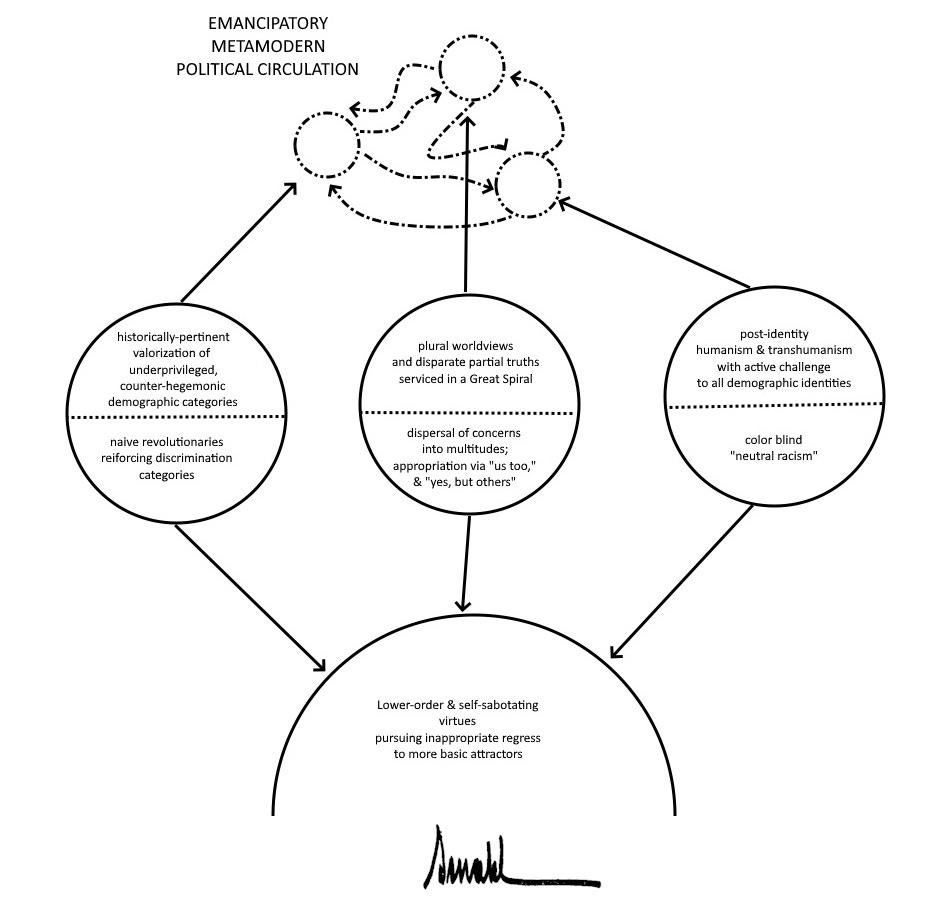
My hunch is that something useful exists in the fact of this tri-valence. But obviously (I hope) not in every version of these three positions. There are more-and-less healthy, intelligent, sacred, humanizing, and naturalizing versions of all these attitudes.
Take Critical Race Theory (which we will touch on later in this essay), for example. It is a common metamodern experience to talk with a proponent of CRT and legitimately find them to be a vapid, racially-obsessed reactionary whose so-called progressive ideals sway dangerously close to histrionic fascism. And yet the next proponent — of ostensibly the same theory — presents a deep, humane, and necessary vision that could help us grow beyond limiting reactionary ideas toward a much healthier, smarter, and more powerful civilization.
From our point of view, there are a small number of potentially valid and interacting views on “race,” which each exist on a continuum of health, nuance & multi-perspectival inclusion. And which may or may not be convergent at some point in a developmental worldspace.
But how did we get to Race in the first place?
II. Some Origins of Racialized Modernity
Racism is both natural & unnatural. Inter-group antagonism is standard among animals. Stereotypes and mythic identities are normal forms of human cognition. It takes extra time and effort to produce rational, humanitarian, and egalitarian souls. And yet it is not natural to live with hate, grievance, and hostile disgust in our bodies. The real ugliness of racism involves a perverse form of embodiment and a protective malfunction of the heart — regardless of what people “think” or “say.”
It is also unnatural (or at least highly historically contingent) for our inter-group antagonism to be organized into abstract “races” that are positioned along a spectrum of normative supremacy & inferiority. Gross. Dumb. And oddly recent. But where did it come from? Can we tell any plausible metamodern tale about this? Let’s try:
Developmental theory postulates a flux of multiple histories in which enfoldment trends periodically emerge. Social and cognitive operating systems are adaptive to particular circumstances, but occasionally new ideas, new technologies, and vaster vistas absorb and replace older systems — just like Einstein’s Jewish model of gravity enfolded, enhanced, and replaced Newton’s English model of gravity.
Several thousand years ago, the system of tribes, villages, and wandering hordes was, in many places, absorbed into what we now call “kingdoms” and “nations.” The administrators of large permanent settlements established a new system of armed, trans-tribal, ethnocentric, and hereditary city-state agrarian kingdoms ruled by oligarchic families who were fronted by a theatrical monarch.
Society and cosmos become viewed as a pyramid. Shamans and witches are replaced by bureaucratic priest-scribes. Concrete-operational thinking (in Piaget’s language) is encouraged. Violence and oath-swearing are used to subordinate regional tribes who must now “patriotically” tithe to the cities, honor the flag, switch to common Book Gods, and prepare their sons & daughters for periodic sacrifice in inter-kingdom warfare.
Yay & Yikes.
Developmentalists refer to this shift as the emergence of Blue, Amber, traditionalist, ethnocentric, scriptural, or mythic-membership culture. However, it is not only ethnocentric, it is ethnogenic. It produces peoples. Spain was not a place colonized by God’s eternal Spaniards. The Spanish people were “created” there over long periods of time. A nation, or a Great People, is the quasi-homogeneous product of extended habits and (often) enormous dehumanizing violence and suppression. These identities are powerful. Yet not powerful enough to resist the next major technosocial upheaval — modernity.
Industrialized, quasi-literate, and ostensibly poly-ethnic Empires and internationalist “nation-states” are wildly transformative. They come along with advanced machinery, constitutionalized technocratic governments, well-funded scientific progress, and math-driven extractive economies. Tough to beat.
However, people do not disappear when you conquer or absorb them. Ethnocentric layers continue to exist within the techno-humanist globalization. An easy example is the ongoing presence of ethnic mafias operating right under the nose of the rational modern justice system. These layers become entangled, interpenetrant (great word), and mutually adaptive. They orchestrate a combined homeostatic momentum.
The result, pioneered in Europe and America from 1660 to 1960, was the dualistic, constitutional, and representational “business-government,” which ruled as an argumentative alliance between liberal internationalists & nationalistic conservatives.
In modernized countries, this new machinery of socialist capitalism required the mass production of fake modernists. Conformists who believed they were individualists. Flat-earthers who are taught to say, “The Earth is a sphere,” just to get through school. Reprogrammable pre-modernists ready to be symbolically swayed by election propaganda and commercial advertising. And this collusion of modernity’s machinery with ethnocentric sensibilities is where we get race.
Historians of race describe it as a surprisingly recent concept that arose in tandem with the New World Order of the last few centuries. It is a poly-ethnic construct. A way of grouping many “peoples” into large, convenient categories.
Never mind Japanese war crimes against the Chinese — they’re all Asians! Forget that there is more genetic diversity within Africa than across the rest of the world — they’re all Black! The Salish and Iroquois have very little in common — except that they both go into the category: Indian! Or Native American. Or Indigenous. Or whatever. And what about the Irish and Italians? Apparently, they were not formerly White, but now they are...? Those Guinea bastards snuck in somehow!
Grouping people into these large blocs is not merely a matter of convenient simplification. These trans-ethnic abstractions perform a structural function within the major modern spheres of geo-political power.
Each hegemony figures out how to self-organize using a primary, racialized, demographic “issue.” Real Americans vs (so-called) minorities and immigrants. Pure Russians vs. the rabble of the other Soviet Republics. The Han identity in China. Trap everyone into an endless dialectic between the official symbolic race and the official anti-race. The default appearance vs. the main alternative. Usually (though not always) a matter of light vs. dark.
Some citizens in these systems can assert racial superiority. Others can challenge and critique racial supremacy. Or people can perpetuate the whole structure by claiming NOT to see race at all. It doesn’t matter in the sense that all three groups go back to work pedaling the efficient bicycle of modernity. There are certainly advantages to being perceived as part of the hegemonic race rather than the counter-hegemonic race, but this difference is not itself the structural source of inequality & industrialized inhumanity.
Yet despite the historically fluid nature and hidden drivers of racial thinking, we nonetheless do have our current system. Responses to the existing social machinery are a kind of weird turbulence between ethnocentric emotions, modern power structures, postmodern critiques (and faux-postmodern critiques that reinforce modernity by trying to solve its problems without changing its methods).
This is what metamodernism steps into.
(Uh, oh. I ended a sentence with a preposition. How about: This is that, into which, metamoderism steps? Ugh. That sounds worse. Go ahead and end sentences with prepositions, people! It was never a real rule.)
So metamodern politics is faced with a complex challenge. It must try to accept the emotional (and medical) reality of ethnicities with unique histories. It must also work to secure the basic dignity of all people, redress particular distortions that embed racist tension into putatively humane systems, transmute both cruel-oppressive & aggrieved-revolutionary feelings, secure humanism while reaching beyond into ecology and healthy transhumanism, upgrade modernity’s economic and decision-making protocols, while sanely deconstructing the basic ideas that underpin the dominant racial dialectic. Just do all of that at the same time. Justice!
We cannot do all that. At least not very well. So we either migrate nomadically between these positions or we specialize in affirming one view within a loosely allied community of people holding other specializations. And we try to live into a culture of transparent identity politics wherein we are neither blind to our particular histories and identities, nor totally fixated by them.
We have to take the situation of a particular group seriously, while not forgetting that other groups also have problems, that groupings themselves are problematic, AND that radical emerging world changes might undermine all of this stuff.
St. They says it might take 200 years, at the current rate, for the average Black family in America to renormalize its economic equity relative to the average White family — but within 50 years, we are going to see a vast wave of cyborgs and genetically modified humans that might make the very categories of inherited ethnicity and gender seem disturbingly irrelevant. What do we preserve, if anything, from the idea of Black & White if the category of “human” is already being undermined?
Theorists of Black Metamodernism often give shout-outs to Afro-futurism. I don’t know how much Indigenous sci-fi they have read, but the so-called Afro-futurists have a beautiful mix of archaic, futuristic, surrealistic, and emancipatory styles that attempt to envision protopian worlds that are more grounded, sociologically aware, and broadly humanist than are the inspiring but somewhat sterile projections of Solar Punk. (As for menstrual futurism? It’s a word I made up, and I’m still waiting for that art form.)
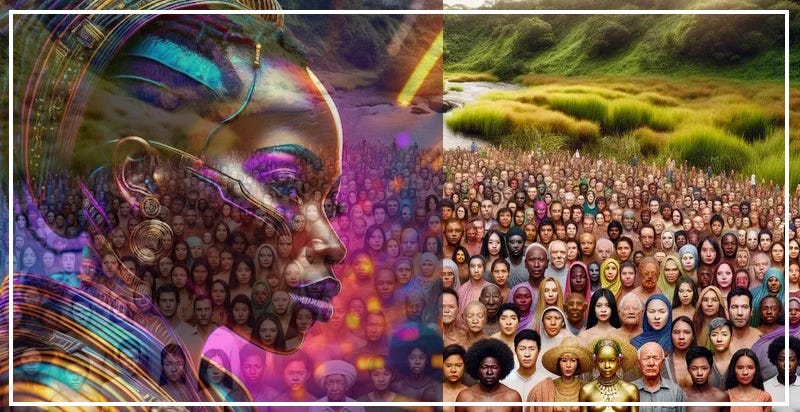
I am a fan of Afro-futurism.
It represents a constructive humanist projection sourced in the complex realism of counter-hegemonic identities. If we attempt the magical art of envisioning futures without a solid grounding in those important human and natural qualities that tend to get suppressed by pro-light, anti-dark sensibilities… then we are probably inching toward another dystopian utopia.
And yet, a racially-aware metamodernist futurism places this important trend into circulation with both the plural futurism of all kinds of groups AND a trans-ethnic, even a trans-species, futurism. Holding all that with a constructive rather than destructive diunality will be a challenge.
Let’s practice with a complex deep dive into holding a serious Both/And about Blackness, Whiteness, and the gradations between them…
III. The Conceptual Whale of Whiteness
But not yet have we solved the incantation of this whiteness, and learned why it appeals with such power to the soul; and more strange and far more portentous - why, as we have seen, it is at once the most meaningful symbol of spiritual things, nay, the very veil of the Christian’s Deity; and yet should be as it is, the intensifying agent in things the most appalling to mankind.
-Herman Melville, Moby Dick.
If you have not read Moby Dick, do so. I’ll wait. That book is far weirder, more multidimensional, and ironic than you think. An entire chapter is devoted to why whiteness is the most terrifying color. True or not, modern thinking is definitely haunted by the spectre of whiteness<>blackness (or lightness vs. darkness).
In the intriguing 2025 film Eddington, a young white boy, who has recently taken up the tropes of the Black Lives Matter movement to impress a superficially woke white girl that he wants to sleep with, explains to his parents at dinner about the long road ahead to “dismantling” whiteness.
“Are you fucking retarded???” says his father. “You’re white!”
There is a cynical humor involved in our inspection of this boy’s superficiality, ignorance, and selfish motives. He is a dummy. There is also, perhaps, a parental complaint that he is failing to realize and support his own identity group. More fundamentally, however, we might want to ask:
Is he white?
What is “white?”
Personally, I have not seen roving gangs of albino supremacists violently attacking the pink-beige people of European descent, yelling, “You ain’t white!” Actual coloration seems to be a secondary consideration. Whiteness is, somehow, very serious but also very abstract, misleading, and flexible.
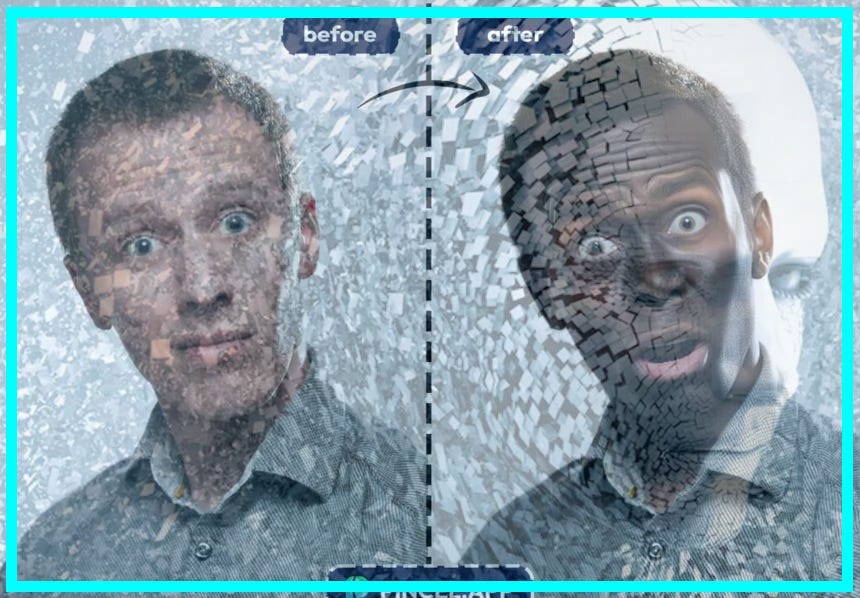
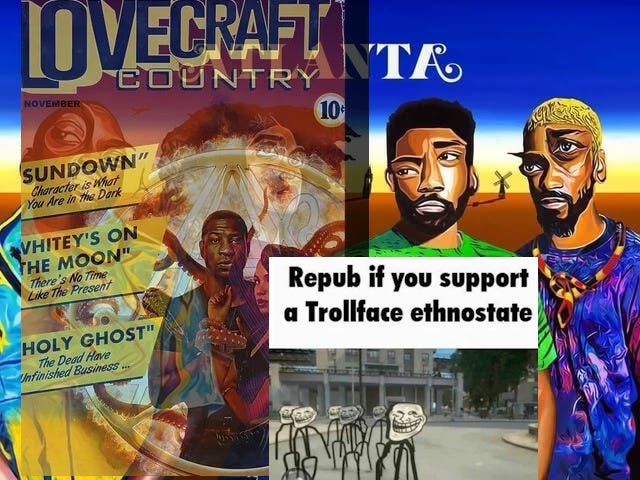
The fantasized qualities of whiteness often lend themselves to purity (virgin snow), wisdom (the white hair of elders), illumination (white light), and the celestial realm (mountain tops & clouds). Here’s a picture of Gandalf the White if he were Black:

I get it. Dark things are harder to see. Not just shadowy caves and moonless nights, but any visually dark entity reflects fewer photons and therefore takes the brain an extra few nanoseconds to process the relevant details. And brains hate extra work! I’ve often said that if prejudice had to be based on something hard to see, like pancreas shape (rather than skin tone, hair style, or breasts), then it would never have become popular.
So visibilist and lazy.
Contracted hearts are an important factor, but if folks cannot categorize it easily “at a glance,” then it probably will not become one of the more popular forms of bias.
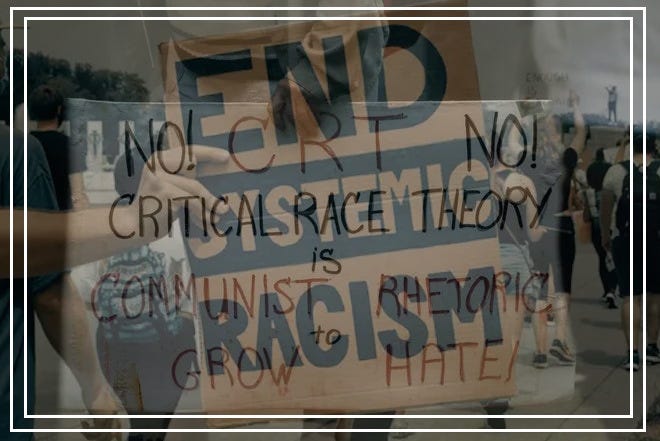
This same laziness of the human mind applies to how we think about our analyses of “race.” Consider the underlying ambiguity of Critical Race Theory (CRT). Does it suggest that we should criticize society based on our pre-existing notions of race — anchored as they are in hasty judgments, ideological categories, and lazy perceptions?
OR does this theory propose that we critique the concept of race itself and its use as a social organizing principle? That last option would certainly take more psychological effort. The amount of cognitive labor we are willing to put into the analysis often determines our interpretation of the theory itself.
Another piece of CRT is the notion of intersectionality. Here, we can also ask whether this means the (hasty, quickly felt) idea that those people who belong to multiple conventional categories of marginalization need to be proactively valorized and preferenced… or whether we are (more slowly) trying to make the multiplicity of human identity categories into the new minimum form of useful discourse?
You will notice that my bias is reflected in how I frame these questions. I am creating a polarization that I believe is aligned with metamodern, integrative, and developmental sociology. I am suggesting that there is a more complex, healthy, and multiperspectival definition of CRT that requires more nuance and presents a deeper challenge to our popular categories. Conversely, there is a more simplistic, faster, and narrower way of holding exactly the same principles, as if they were simply commentaries on the unquestioned status of assumed cultural designations.
The kind of “discriminating intelligence” (which is both a Buddhist and a racist joke) that I am invoking seems pertinent to evaluating a specifically metamodern set of approaches to a politicized concept such as CRT.
The generalized intra-metamodern discussion is not between pro-CRT and anti-CRT attitudes but, rather, between the more nuanced, critical, and developmental forms of both pro & con. In contrast to the shallower, cruder, and hastier forms of both pro-CRT and anti-CRT.
However, there is a caveat:
While we must expect that meta-sensibilities refer to the way these ideas are held rather than which “side” one is on, there is another relevant consideration about the ideological role of Critical Race Theory in contemporary North America.
The popular anti-CRT rhetoric typically betrays a level of fervor and organization that suggests a reactionary and oppressive (anti-humanist) orientation. Although I personally have enormous skepticism about weakly implemented and narrowly idealistic forms of social dogma, such as we find with many real-world examples of the institutional enactment of CRT training, I nonetheless have much more concern about the rabid flare-up of decadent social forces reacting instinctively against these theories. Methinks they doth protest too much.
Whatever CRT “is,” the anti-CRT appears to be a symptom of lurking and organized networks of regressives cultivating and leveraging widespread peripheral distress (up to and including sensible pseudo-metamodern critiques about “imbalanced” CRT implementations).
For me, the most honest and interesting reason to be pro-CRT is simply an objective evaluation of which groups are the most anti-CRT. As with many things, it is the social pushback that reveals where the constructive evolutionary forces might be active.
Taking that caveat on board, we nonetheless expect that a metamodern approach to CRT is critical of that model whenever it exhibits merely postmodern attitudes. We would like to critique those attitudes, yes, yes, but only as an extension of the critical insights that power those attitudes themselves. This is analogous to the well-known metamodern criticism of Relativism as an absolutism that must itself be relativized.
Postmodern critical and political commentary on race seems to be very good at pointing out how modernized traditionalists reify the concept of race as an essential, God-given, hereditary identity whose purity must be defended at all costs. And it is also very good at finding subtler versions of this reification hidden within the systemic organization of modern neo-liberal “progress.” (And some progress indeed was made!)
Yet this level of critical theory itself tends to reify races by treating them as essential categories that are privileged as unique revealers of the subtle and systemic injustice of modern hegemonies. And what could be more obvious than such a sentence!
My apologies.
One of our challenges, then, is to be able to apply postmodern ethical, sociological, and revolutionary critiques back upon themselves without losing touch with the deeply humane insights that provoke the best versions of those critiques. And to make those distinctions, we probably have to think and feel (with more nuance) about the significance of revolutionary and progressive sentiments in general…
IV. Fascist Revolutionaries?
In Paul Thomas Anderson’s 2025 film One Battle After Another, we meet the beautiful black political revolutionary named Profidia Beverly Hills. Very inspiring.
However, her revolutionary zeal is soon revealed to have strong narcissistic and erotic dimensions that trump her commitment to social ideals & family relationships. Her actions leave her allied with a terrible man who represents the very symbol of oppressive social forces. Yet he, too, does not really care about his “side.” They bond over some shared perverse drive that possesses both the White hegemonic enforcer and the Black insurrectionist.
Metamodern politics must reckon with the psychoanalytic possibility of a subterranean collusion between champions of change & the gatekeepers of the status quo. Under what conditions do systems-of-oppression run on the same inner fuel as the emancipatory forces? And to what degree do apparent and aspirational emancipators operate unintentionally as part of the overall regime?
Meta-progressives (and, of course, meta-conservatives deserve a whole essay of their own!) often side with some version of a progress movement struggling against reactionary impediments; challenging the lower-level virtue claims of people whose actions support a default condition that impedes humane upgrades to the technosocial order. Good. Yet we must supplement this general orientation with a careful investigation into the Spirit of Change itself.
Revolutionary and transformative feelings may suffer (at least) three faults:
a tendency to ignore the evolutionary complementarity and simultaneous need for progress-liberation (left) & conservation-restoration (right) principles.
a blindness to the manipulative role that the revolutionary feeling can play in the motivation of fascists, authoritarians, and the defenders of a decadent status quo.
a failure to deeply grapple with the deluding effects of the very traumas and imbalances that make people sensitive to perceiving real “injustice.”
Those three, taken together, represent the main cluster of points that I hear most often from post-postmodernists who are wary of revolutionaries. There are, of course, counter-critiques that problematize that very wariness, but we are looking from one particular side in this section of the essay.
I would ideally take a playful deep dive into each of them, but for the reader’s sake, I will just do the second point. This essay is already quite long and I have cut several important sections out.
The story goes like this:
Once upon a time, quite innocuously, I was seated outside a Starbucks cafe in Victoria, BC. Idly, sipping an espresso, I perused a sign affixed to the front window. It indicated one of those temporary, excitement-boosting “campaigns” that franchise restaurants are endlessly devising. It read:
“Who Says Mocha Can’t Have a Summer Sidekick?”
Clearly, some kind of caffeinated sugar-milk drink was being added to the summer menu as an alternative or complement to their Mocha drink. Obvious. Not worth thinking about. Or was it? I started to take the question seriously. Who, I wondered, does actually say that Mocha cannot have a Summer sidekick? Then it hit me — no one.
Nobody says that! It is like clickbait that tries to sucker you into their scam by offering to reveal what THEY DON’T WANT YOU TO KNOW! Why isn’t the mainstream media covering this??? It stirs up a feeling of rebellion against an abstract authority. And it does this to manipulate you.
Not only does No One stipulate that Mocha is not allowed to have a summer sidekick, but the real purpose of the revolutionary counter-impulse stirred up by the slogan is that I should give money to this multinational corporation.
So: How much hegemony and manipulation is stimulated by the feeling of a revolutionary counter-impulse?
How often have you heard from Christians (still, by far, the dominant religious group in the Americas) that they are only valiantly fighting back against unfair suppression? Did they become dominant by endlessly pushing back and rising up? Do dominators always feel like underdogs? Can the enforcement of a biased normalcy ultimately be separated from the moral emotion that resists and rebels? Does oppression result from, or feed upon, the very desire to reassert freedom? Is that what happened to the French Revolution? Etc.
We know very well how reactionary authorities assert further control by pushing back against putative insurrectionists, okay, but how often are the agents of hegemony themselves motivated by a feeling of ethical insurrection?
We have all known youthful radicals and anarchists who were the first get bourgeois homes and families. Was their conventional rebellion a sign of their secret conventionalism? Perhaps all rebellion is secretly conventional.
Remember when those ancient ethnic-national kingdoms started to take over the tribal/regional groups? The instinct of unique tribes to resist incorporation into large, mythic peoples had to be redirected. That same energy still existed in bodies and communities, but now it was rebranded as patriotism, loyalty-to-symbols, and an aggrieved readiness to “rebel” by enforcing the new norms on any deviants or rivals.
Quickly! We must keep THEM from destroying y/our way of life! Just sign here…
These are interesting ideas. They do not mean that we give up the struggle for humane and ecological thriving, but it does mean that we cannot do this well — certainly not at a metamodern level of cultural complexity — without a diunital awareness of the hidden duality of revolutionary impulses.
In/Conclusion
This article has been about the potential complementarity between the main metamodern political attitudes. We have explored it through the lens of Race. That can provoke a lot of anxiety. Real people are attacked every day by people who act as though they believe in racial distinctions. These attacks can be symbolic, economic, or physical. Those are not equal kinds of attack, but they are all real.
Talking, thinking, and feeling through the lens of Race is a skill. We can all get better at our own version of it. I probably still have a long way to go. But I believe this skill involves, among other things, an increasing appreciation of context.
Context is the niche into which your facts fit. A big city like New York could have the highest number of violent crime deaths annually, but it might also be the safest city in America. Howso? Well, what if it had the lowest violent crime rate relative to its population? That is a context question.
Maybe the greatest number of people killed each year by American police are White men, but, at the same time, a much higher percentage of Black men are killed by those same cops. Context makes all the difference. Postmodern critical sociology starts to take contexts into account, but metamodern sociology must find ways to do this more powerfully and gracefully.
Regular subscribers will know that I routinely think in terms of three other social contexts — exoteric, mesoteric & esoteric. Each of them provides a different style of relating to racial discourse.
For example, “exoteric” communication responds to normative social habits. Today it sounds fine to say Black, but rather outdated (or poetic) to say Negro. And intolerably upsetting to say the so-called N-word. The favored and disfavored words have shifted many times and, at some point, will shift yet again. Society is constantly negotiating its language and official attitudes.
Often, that negotiation is downstream from the repeated conclusions of smaller avant-garde networks. These “mesoteric” groups need to feel into the deep, leading-edge realities of the moment to collaboratively work out the language we need in order to inspect, validate and/or transform culture. Their job is to experimentally figure out how we should talk relative to our values, histories, and the worlds we wish to create.
And then, of course, there are “esoteric” spaces in which people are training to see and feel beyond the implications of socialized language and symbols. Spaces of sacred transgression in which the most offensive and regressive thing we can do is to reinforce the superficial dehumanizing power of common emotional assumptions about patterns of letters. These people wish to fuck with the social charge, positive or negative, associated with human speech.
Context.
But how anybody know if they is doing context good???
Excellent question.
Metamodern & metacontextual approaches to politics in general, and racialization in particular, need principles by which to evaluate and improve themselves. And to become more real and useful than just some abstract multiperspectivalism.
Nassim Taleb talks about skin in the game. There is a layer of embodied human intelligence that we cannot access if we are insulated from the consequences of our decisions. If you can crash the economy, get paid out, and jump to an even higher-paying job, then you do NOT become a better banker.
Meritocracy fails if the “merit” we are rewarding is simply the ability to convince people to pay you elite sums of money, whether you succeed or fail. This is part of the meaning of “privilege.” It is a combination of luck & insulation.
You can do psychological studies on people playing a game like Monopoly. Rig the game in their favor and they immediately start believing that victory was the result of their superior skill or intrinsic virtuous identity. They normalize luck and do not consider hidden systemic factors. We can all get high on fluke outcomes. Ethnicity, gender, history, neurodiversity — these are fluke outcomes. They are not the result of our efforts.
Certain circumstances give you certain advantages and disadvantages in certain contexts. Obviously. It is not always a privilege to be White or male or from a wealthy family. But it often is. As someone with two of those traits, my opinion is that there is enormous room for a metamodern inter-privilege discourse.
That means learning to trust each other enough, and to be curious enough, to explore the forms of luck and insulation that we each have normalized. No one has all the privilege. No one has none of the privilege. And not all privileges are equal in importance. Intersectionality is a great way to begin to explore that, but it starts to fail, and to reveal its merely postmodern sensibility, as soon as it is weaponized against an assumed class of easily-recognized, homogenous people upon whom we project all the privilege. This weaponization inhibits the ability of these discussions to provide a stabilizing and challenging form of feedback.
Or maybe that’s just my racism talking.
I would have loved, in this essay, to explore the contrast between “systemic bias” and “intersystemic bias,” between equity of opportunity and a hystericized anxiety about enforced equality of outcomes, between mean average wealth & median average wealth as the driving economic metric relative to trans-ethnic humanitarian thriving, etc. I cut all that out. This article is already long enough.
Let’s just say that the interrelated cluster of socio-economic and political positions espoused within metamodern communities requires, yes, that we flesh out an ethical position on matters such as “race,” in a way that both conserves and transcends postmodern positions, not only as knowlege but as our embodied way of being in the world, which we can only do with a combination of developmental nuance and constructive interpersonal challenge, BUT that we also have to couple that to proposed and enacted changes in the actual systems by which wealth, health, meaning and power are re/generated in our societies.
Admittedly, that’s kinda hard to say.
And, even more admittedly, saying it isn’t enough.