
Metashamanics II (free version)
The Intervergence Sessions

(Welcome back. These unique, complex & stylized articles are prompted by queries and themes sent to me from across the developmental, transformational, and regenerative fields. Subscribers to the pro-version recently received a short analysis of the concept of ‘coolness’ and the author’s audio version of this current report about the BC Metashamanics gathering. They might also be getting an updated position statement about so-called UAP Disclosure.)
I. A FIELD REPORT FROM THE ARCHAIC FUTURES
Last year I composed a general introduction to Metashamanics. That is a speculative theory about the care, history, & ongoing usefulness of shamanoids in the emerging Global Village. Shamanoids are imagined as the socially and genetically conserved class of neurodiversities out of which candidates would anciently have been selected to serve as an organic priest, witch, shaman, weirdness worker, or gnostic intermediary for the human tribe.
This is not directly associated with people who self-identify as ‘shamans’ or even those who are believed by their own culture to perform such a role. We are discussing a general temperament and proclivity that emphasizes particular interests and capacities that are found in all of us in various degrees.
I am not going to spend any more time here on the broad introduction. You can click the link to the first article. The current piece you are reading will go beyond overview into further explorations. These are things that have been arising at the leading-edge of this new shared discussion.
Most of this will be a summary of the results from a recent collaborative retreat (or think tank and/or ritual space) that occurred on the British Columbia coast in April. It was in the glorious Land of Seals, Otters & Kingfisher magic — attended by myself, the Endemic team, and several other allies from very different backgrounds.

We held and recorded group sessions that moved fluidly between patterns of convergence & divergence. The word ‘intervergence’ came up. I liked it. In my mind, the current essay harvests the memetic results of the intervergence sessions.
So what follows is a sampler platter. A collection of our questions, problems, slogans, and future pathways for exploration. There is a logic to their sequence but you should feel free to jump around between these chunks and find the bits that are most intriguing. My goal here is not to present a single argument but rather to give you a rough sense of the terrain.
The underlying through-line of our gathering oriented around a single deep question: What role do people with mature shamanic capacities play in a world facing civilizational-scale disruption?
Incidentally, here is a quick refresher on why we use the (sometimes obnoxious) prefix “meta” —
First, it is a connection to broader “metamodern” or “metacommunity” movements. These are a developmental, transformational and regenerative networks who are interested in reviving organic, multidimensional spirituality in resonance with a post-postmodern sensibility.
Second, we are working partly as a response to the metacrisis/polycrisis. This is the idea that shamanic dispositions may be uniquely suited to navigating the challenges of this historical moment and performing a crucial function in human collective sapience and adaptation.
Third, the idea of ‘meta’ invokes a higher-order reflection on shamanism itself. We are questioning how lineages form, how they are vetted, and whether they are healthy, etc. — rather than simply validating, inheriting and upholding traditions.
Perhaps that second point was the most salient one for our gathering. A recurring theme was that many of today’s converging crises (e.g. mental health, ecological disconnection, the rise of nonhuman quasi-intelligence like AI, entheogenic illiteracy) correspond suspiciously well to skill sets that traditional village-level shamanic, oracular, or priestly figures once provided. Our emergent argument is that these roles have been lost at scale, and that clarifying and amplifying those skill sets is now urgent work.
But what did our gathering specifically discuss?
II. THE HAND & THE GLOVE
A recurring topic was the Big Alignment problem.
Most of us are familiar with the little alignment problem. That is the question of how AI technologies can be oriented to serve (“align with”) the values of general human flourishing. That is a component of the Big Alignment problem. Our bigger question is: How can the noosphere & biosphere be collaboratively oriented in service to general organic and cosmic flourishing and meaningfulness?
In other words, how do psychological, social, and technological domains come into productive alignment with the most successful patterns found in deep ecology?
Our Big Alignment problem views the shamanic task (i.e. transrational socio-ecological wisdom work) as part of the same general project as science, technological innovation, art, and healing. All of these are attempts to serve deep and ancient ecological trends through their reciprocal alignment with human techno-social organization.
As planetary technological disruption accelerates, we face an underlying question about whether shamanic capacities — particularly around meaning-making, collective coherence, and navigating non-rational dimensions of experience — become more valuable, not less. Is there an increasing need for people who are specifically devoted to the transrational task of improving the Village/Nature alliance at all levels? People whose inner ecology suits them to assist in civilization’s interiorization of ecological principles?
I have been using a metaphor for this in which naturalness is the ‘hand’ while techno-social capacity is the ‘glove.’
Put the hand into the glove.
Sounds good. But what is inhibiting this process?
Our group identified cultural fragmentation as a general condition thwarting individual existential development, community-building, meaning-making, politics, depth, sacred experience, etc. All of these problems could be analyzed in terms of insufficient cultivation of interpersonal cohesion, intergroup cooperation, and transdisciplinary coherence. Cultural fragmentation. Is that a cause or effect of having, in general, a lack of matured, coordinated and socially valorized “shamanic” types? Probably both.
In our dialogues, this fragmentation was connected to a monoculture mode in both our religious and secular activities. In agriculture, we are aware that monoculture crops are an attractive method for efficient control and mass production, which nonetheless frequently lead to soil collapse, malnutrition, ecosystem dysregulation, weakened immune systems, corporate cannibalization of local farms and families, loss of long-preserved agricultural lore, etc. These methods, which are not the only ones that could be used to produce large amounts of sustenance for human beings, are socio-technological activities poorly aligned with the richness, complexity and interconnected non-linearity of the natural world. Perhaps we need a stronger social presence of ideas, practices, and characters who prominently focus on a more thriving mutual adaptation between human principles and natural principles.
That is an obvious place where a para-shamanic intelligence might play an important role. However, we need to follow this thread into a larger context. A more ecologically-honest model of food production must be joined by a similar attitudinal shift in other cultural domains.
The well-known issue of political polarization represents large blocs of the population trying to organize themselves into homogeneous monocultural zones. We can only tolerate our own side — imagining the Others are diabolical enemies of the nation. We only want news that fits our shared bias and does not trigger us with pernicious views. Virtue tests, policing of communication, ideological conformity, etc. are common traps that operate by analogy with monoculture crops.
Even our approaches to “religion” (i.e., existential development, meaning-making, and shared spiritual practices) operate like a single crop. The common idea of a homogenous universal Deity, or a single reproducible holy book, is analogous to monoculture attitudes that do not seem to correspond to the ancient normal diversity of the human sacred ecosystem. Having a few massive “religions” is similar to having a few giant fields of genetically self-similar corn and wheat — rather than the kind of flourishing plurality of interdependent species envisioned by permaculture & rewilding movements.
This is not an argument that there should be no large farms or monotheisms in the world. However, we should regard biological or social monocultures as potentially dangerous. They may typically create fragility, corruption, and dysregulation of complex, nonlinear organic systems. I.e., they may represent a failure to establish constructive, long-range alignment between noospheric and biospheric needs.
Even the notion of the “divine” or “transcendent” or “emptiness” that has become standard over the past few thousand years is imagined like a single crop. We envision and discuss our concepts of the Transcendent Value Being as though it were obviously an extra-cosmic unity, singular identity, and homogeneous quality. The One or None. Yet this is not consistent with the shamanically cultivated version of the sacred that held sway for the longest period of human history. Nor does it correspond to the leading edges of contemporary science, philosophy and art.
Thus we may need to consider a new-and-archaic vision of biodiversity, rather than homogeneity, as the adequate description of Divinity. We may need to presume that the nature of the Ultimate is more like the interconnected richness of a thriving ecology. Deity need not be a monoculture. In a more shamanistic version of all cultures and religions, we might feel God as Shoal, Telos as reef, Shunyata as biome.
Our sense at this gathering was that monoculture is a failure mode of development.
We also considered the concept of enabling constraints — borrowed implicitly from complexity and systems thinking. What intentional limits or structures allow genuine differentiation, depth, and learning to emerge?
A historical example we discussed was the system of ancient Greek city-states. They shared a language and broad culture, but information traveled slowly enough that each city developed with its own distinct character. For the flourishing of diversity, there needed to be a constraint on how much sharing occurred. Too much consensus, obedience or coordination can diminish the vitality and intelligence of a system.
If shamanoids continue their archaic task of mediating between “village” and “wilderness,” then they are tasked with enabling anthropological systems to work, and to resemble, the flourishing of complex ecological systems. This seems to happen when sociological dynamics hover constructively around sweet spots that are enabled by a special balance of interconnectivity & separation.
Enabling constraints may include intentional slowdowns or limits that allow for genuine differentiation, learning, and cultural diversity to emerge. This was offered as a counterweight to hyper-connectivity and always-online culture. Destructive mass effects may emerge spontaneously when there is too much similarity.
Related to this, several people noted strong contemporary cultural movements toward embodiment, in-person experience, and presence. Somatic experience, in-person gatherings, reading books, getting offline, and a rainbow of new Luddites may be signs of a healthy counter-movement to a form of digital acceleration that excessively interconnects us.
Here, the matured and supported shamanic type of person may be able to template and advise on the use of these enabling constraints. Speaking of advice…
III. SHAMANIC MENTORSHIP
We spent a lot of time pondering how to heal the teacher-student relationship.
We looked at abuse potentials, modern shame around the lack of perfect knowledge, the broken container between teacher and student, etc. A metashamanic revival for the Global Village must begin to repair this container. Learning from one another in a trusted, embodied, relational context was seen as both a practice and a model worth seeding more broadly. And, in fact, this is part of what we were already modelling together in our gathering.
Collectively, our culture faces the questions of eldership & apprenticeship, intergenerational transmission, healing ancestral trauma, and remaking teacherly authority without unnecessary forms of hierarchical abuse. Teaching is very important. Yet at the same time, there appears to be something uniquely organic and self-sourced about the unfoldment of shamanic training. This tension needs to be explored.
Outside of traditionalist, institutional imperialism and modern commercial cultures, there is a great deal of focus, in spiritual and therapeutic training, on idiosyncratic and self-selected forms of maturation. For example, there are very old patterns of inner searching, “land listening,” solitary journeying, and the unpredictable discovery of personally evocative insight fragments and proto-skills. These are all quite personalized and unpredictable in the way they unfold.
Unlike the trainings received in large, popular and official religious traditions over the last few thousand years, this ancient alternative was frequently more about providing opportunities, stories and liminal conditions in which the apprentice produced their own embedded ecological wisdom, imaginal capacity, and personal style of ritual interventions.
Yet that does not mean that more shamanically-informed approaches lacks mentorship, information sharing, or the directed cultivation of understanding. Such approaches involve deep veneration for the experience, nuance, and the attitudinal shifts that accompany eldership. Teachers and mentors are still crucial. The metaphor of vertical difference in knowledge, competence and beingness, may be more relevant than ever. However, our group flagged the fairly obvious point about the wounded nature of teaching and learning within contemporary culture.
This involved paying attention to the tension between healthy & pathological versions of mentorship. To cultivate a more broadly shared intelligence about the failure modes of esoteric education appears necessary. We must not only “map” healthy diversity and subtypes of wisdom work but also the shadow variants of our teachers and exemplars. The question of how we educate and mature our shamanoids involves not just a fantasy about benevolent, high-integrity esoteric characters but also the sober appreciation of cult leaders, abusers, and complicated people with enormous capacity whose general character development does not keep pace with their leading-edge.
Dark versions and failure modes allow us to build discernment. Not only that, but it duplicates the core shamanic skill — often overlooked in institutionalized monoculture wisdom traditions — of exploring the dark and grotesque facets of living experience. Nature is full of rot, poison, disguise, and rapacious appetites. Not only those things, of course, but an ecologically aligned approach to social and existential wisdom development has to be very upfront about darkness, danger, and immaturity so that it can play its role in gardening these forces toward more mutual flourishing.
Our group told many stories, from personal observation, about prominent and exciting shamanoid figures whose status, function and community networks underwent disturbing ruptures. Often there was a pattern of a long-accumulated build-up of significant energy, insight and potential, and then fracture. Turbulence. Fissure. Dissonance within a lineage. Popular disgrace of a teacher (with or without their socially irresponsible behavior). This fracture pattern was common across traditions and worldviews. So common, in fact, that we had to ask ourselves where this was evidence of pathology and where it might be the messy version of a natural process of growth via schism.
We reached for the phrase normal accidents — an idea from systems theory. Beyond a certain complexity threshold, accidents are not failures but structural inevitabilities. They represent a living system either struggling with the oversimplification of its habits or the adaptive challenges of its expansion and unfolding.
So the question becomes how to design for resilience rather than perfection. How do we consider that apparent ruptures, breakdowns, or even polarizing controversies within teaching lineages could be examples of an uninspected organic process that adds crucial turbulence and variety into systems?
Yet that does not minimize our need to understand patterns of the problematic fracturing of a teaching context. We attempted to grapple honestly with how frequently shamanoid-like figures become cult leaders or abuse their roles. Several real-world examples were named and discussed. In general, however, we felt that most of these examples, despite involving individual shadows and attitudinal habits, were not purely reducible to a character failure.
When a person has genuine and unusual capacity, but there are no peer networks, no vetting systems, no community lore for how to hold complexity and hold the person accountable, the “energy” has nowhere clean to go. The answer is not necessarily more rules, condemnation, and puritan enforcement but a better overall ecology. That means informed peer communities. It means a sense of what structural layouts are needed within a field of mentorship. Discernment protocols are needed. And there must be an open cultural conversation about healthy versus unhealthy shamanic mentorship (in a way that does not exaggerate the input of fragile, moralistic reactivity or dominant social prejudices that are blind to natural complexity).
But do we even know what we mean by a word like “mentor?” Our conversations identified several distinct forms of mentorship that are often collapsed into one word:
The fleshed mentor — a living person you meet who helps you unfold your specific path.
The posthumous mentor — someone from another era whose writings or artifacts speak directly to your experience (Terence McKenna was offered as an example).
The cultural mirror — we mentioned popular artistic figures like the 3 Davids (David Bowie, David Byrne and David Lynch as para-shamanic art figures from Anglo-American pop culture). These are not shamanic mentors in any explicit sense, but their work serves the double function of (a) signalling affirmation of the weird and helping shamanoids to feel less alone, and (b) providing the cultural service of reflecting ordinary village life back to people through the de-familiarizing lens of the liminal, strange, otherworldly, and subconscious.
The path-specific mentor — here is someone who seems to have a very specific specialization that may or may not be your own. For example, they teach trance drumming or Sufi dancing or esoteric Christianity. Their devotion to their own specialization must be held in such a way that you can benefit from their mentorship whether or not you end up joining that specialization.
The peer or spiritual friend — someone, regardless of their degree of being and understanding, with whom you exchange experience openly; the Buddhist term kalyanamitta is referenced here. Here the mentorship context may still function but it does not operate via an openly asserted status differential.
The elder — distinct from a mentor, but noted as almost structurally absent in our communities. These are people who have had more experiences and retained their basic curiosity, resilience, and dedication to their idiosyncratic path within complex ecologies. Two problems appeared obvious to us. Firstly, we need to get better at determining who is a functional elder — as opposed to merely an older person we wish to respect. Secondly, many of the people best suited to be elders in a contemporary sense do not identify with that term. They may need to be tricked into operating as elders in order to help regenerate mature intergenerational transmission between shamanoids in a civilization that lacks these concepts.
So those are a few variations of the human mentorship role through a neo-shamanic lens. A more complete set of these options would need to be considered as part of an intelligent approach to shamanic education. However, there are also seemingly indirect and “transpersonal” forms of mentoring.
For example, we considered transjective synchronicity as as form of mentorship.
That phrase came up in response to storytelling in which people recounted being guided by salient coincidences. There were situations in which their gifts, predilections and life-paths were moved forward by coincidences, miracles, and puzzles.
Often such episodes occurred in response to emotional crises within younger shamanoids. Also they frequently involved a prolonged period of semi-trance in which nonlinear navigational “clues” were followed. Realizations, insights, and practical chunks of one’s own wisdom were often the result.
Regardless of the objective reality, the lived experience was that of a non-personal organizing intelligence, or else particular “spirits,” that provided the kind of self-clarifying and orienting encounter that a mentor would otherwise provide.
The word transjective points to something that is neither purely subjective nor purely objective — it crosses or blurs that boundary. This kind of extended mentorship does not require any particular beliefs about a “guiding power,” but it does seem to involve attentive and repeated probing into meaning patterns that evade the typical subjective/objective distinction.
We found it important to note that these forms of self-sourcing in shamanic training are not gestures of isolation. Nor do they signify willful independence from lineage. Rather, they are an affirmation of the contextual and ecological unfolding process and the requirement to gain some skill in the dance of meaning.
The dance is a way of cultivating these two shamanic capacities:
(1) staying in close dialectical flow between uncontrolled, emergent, potential significance in the environment and one’s own playfully held analytic intelligence,
(2) sustained use of liminal meaning-making states in which symbolic and affective connections could move in any direction.
So skill in this area is twofold. Firstly, developing a basic appreciative competence for how to start, follow, and move with potentially “unreasonable” signs. Secondly, a grounded capacity that does not have to believe these signs in order to access them.
That second capacity also becomes important for the mature shamanoid who, among other things, may be required to help community members to step outside their belief systems and become more pragmatically tolerant of cognitive dissonance.
Together these two skills can engage a kind of “third space” that holds the subjective/objective boundary as fluid. This is a means of moving between the overly regimented collapse of meaning-meaning and the indefinite expansion of combinatory explosion. Contemporary cognitive science highlights this problem very explicitly. Meaning fails if it gets too locked down OR too wide-open. It thrives in response to exploratory inhabiting of the space between.
While the right kinds of inner balances may open “situations” as mentor-like phenomena, it is also true that many things may shut down or degrade normal teacher-student dynamics over time. For example, we probed the commodification problem in mentorship. It seems likely that genuine mentorship can sometimes, not inevitably, get distorted when money enters the relationship.
The conventional education situation of contemporary for-profit universities has been widely critiqued. While this criticism is sometimes overblown, it does appear that expensive educational institutions become corrupted in many ways. Professors lose power to the financial administrators. Oligarch families and fragile students expect to get what they pay for — and avoid difficult topics and developmental complexities. Anxious fiefdoms emerge between scholarly departments. And a general atmosphere emerges in which educators self-censor and over-accommodate as a result of the financial dynamics.
It is unknown the degree to which monetary exchanges might pervert or constrain educational relationships in a shamanic context. Our group ended up distinguishing between a teacher (who you can find and pay for explicit skill transfer) and a mentor (who tends to appear serendipitously and operates outside transactional logic). That distinction was at least a starting point.
However, it leaves open the problem of elders. These people need to have their material needs met in a way that allows them to prioritize the direct and indirect sharing of their accumulated beingness & understanding. How is that accomplished without an exaggerated risk of the relationship itself becoming a commodity?
The problem of direct and indirect sharing included an exploration of what we might call “transmission” as a biological and energetic phenomenon — not just a symbolic and informational process.
A passage from Stephen Harrod Buhner was referenced, describing energy passing body to body from his grandfather to him in a woodshop. Not as an intentional teaching but as something physiological and organic.
This prompted reflection on the absence of adequate mentoring (which we sometimes called the Odysseus problem because the absence of that cunning hero meant that his son Telemachus needed a substitute teacher in the form of a character named Mentor. That is where we get the word). Our consideration was whether the absence of adequate mentors might partially be downstream from a neurophysiological resistance, or lack of capacity, to receive subtle but physically real forms of non-symbolic information.
Maybe it is the case that older bodies, if they have lived in certain ways, create containers for some “substance” which younger bodies could absorb. Yet we may not be training people to be able to receive. Or perhaps our current environment creates patterns of resistance and avoidance that tend to inhibit these imagined transfers. In either case, this inability to acknowledge and assimilate these flows may be responsible, over time, for the obsolescence and absence of certain kinds of mentors from our consensus spaces.
In the esoteric culture of India, there have been socially recognized patterns such as (a) people retiring from business and family to become focused on “the sacred,” and (b) traditions of satsang & shaktipat in which the embodied company of particular mystics was understood to perform a maturational function.
What could be gained through an intelligent contemporary normalization of such ideas about mentorship?
Overall, our group became increasingly convinced that it is important to draw distinctions between proclivity, practice & purpose.
That means that having shamanic capacity or temperament (i.e. proclivity) is not the same as having developed those capacities and interests (practice). And neither of those is the same as actually deploying it in service (purpose) to a community or an ecosystem. This tri-part distinction is central to what any diagnostic or typology system for shamanoids would need to track. We must not naively conflate people who are “onto something important” with the realization of stable skills and insights, nor either of those with being a mature, ethical, and grounded person in their ability to use this for the well-being of others.
So mentorship and esoteric education assume that the proclivity can be detected and then must be assisted toward the maturational cultivation of practice and purpose.
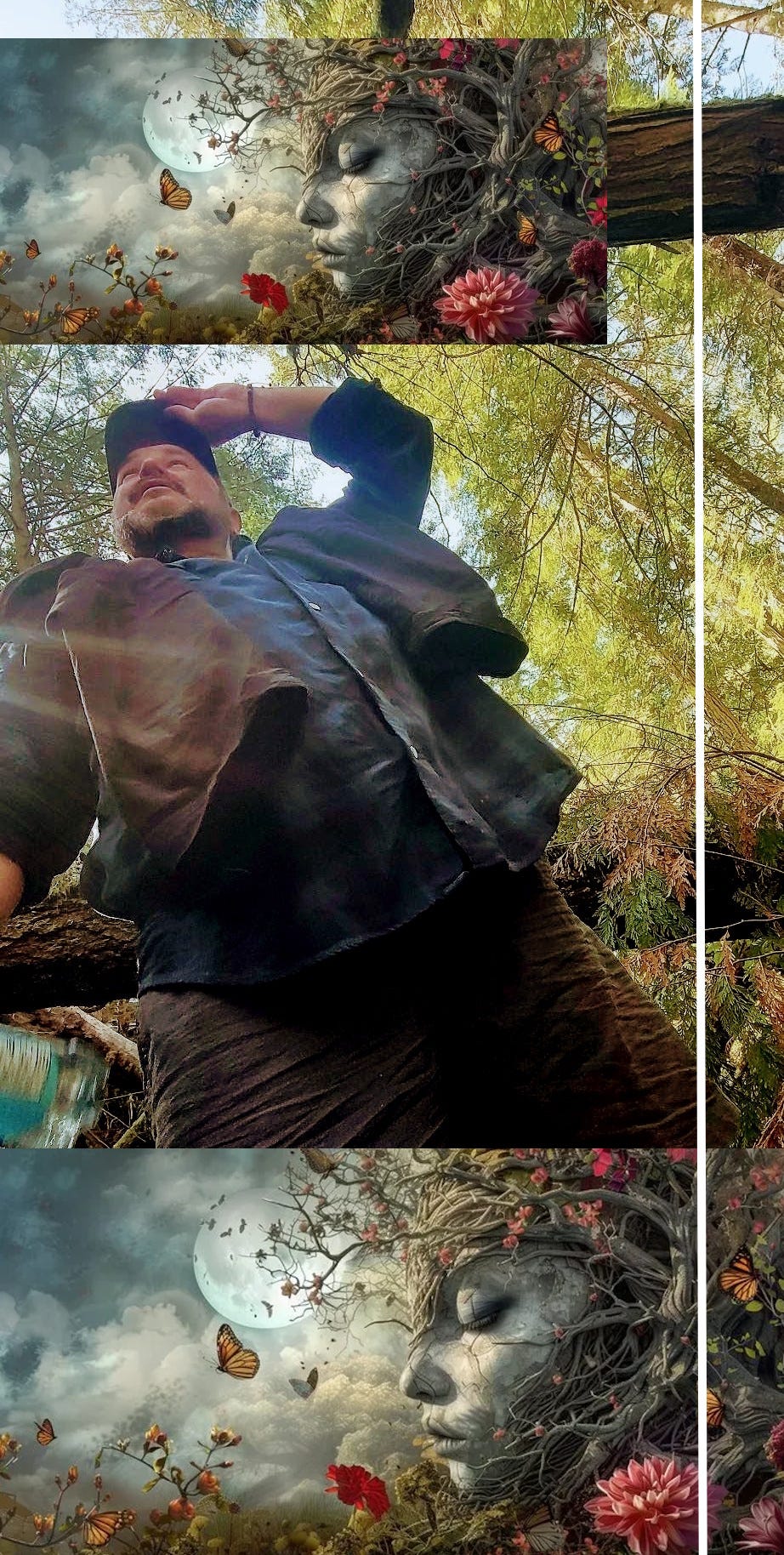
(And here’s a picture of me at the gathering.)
Once we have made that distinction, we can then look more closely at the “proclivity” element. What are its different forms and where does it tend to occur?
We considered the problem of informal or concealed shamanic functions. For it is certainly not the case that everyone who has matured esoteric competencies and service orientation is self-identified as shamanic — or publicly advertised as such.
It is certainly true that many people who self-identify or self-promote as “shamans” may not belong to the category that we are exploring. Conversely, many who do belong to this category might not like or identify with those terms. And certainly many may not be involved in selling themselves in a professional sense.
So we must take seriously the possibility that a portion of the shamanic function in human communities has always been invisible and unprofessionalized. The example given is a grandmother or mother who just does that thing — orients people, holds space, reads situations, brings ecological complexity, etc. — without ever naming it or offering it as a formal service.
We started to use the tow-truck metaphor. I.e., someone notices a natural communal behavior such as helping people out of ditches. Then they professionalize it by starting a tow-truck service. It serves a purpose, and it scales up the behavior, but in the process it may strip something natural from the situation and it may also obscure the ongoing presence of casual or non-designated helpers.
Is the explicit presentation and professionalizing of the community’s shamanic function a step up? A step down? Sideways? This question was raised but left open for further inquiry.
Alongside that question, is the realization that many mature shamanoids might be hiding in plain sight. Any diagnostic tools we develop would have recognize that this role, and its associated interests and capacities, could be appearing as a systems theorist, artist, filmmaker, community organizer, environmentalist, therapist, or scientific researcher.
The Nobel Prize-winning biologist Barbara McClintock is offered as a case study in institutionally deployed shamanoid capacity. She described becoming the corn chromosomes while looking through her microscope, experiencing insights in a non-dual state before designing the experiments that later validated them. This is presented as exactly the kind of paradigm-breaking scientific contribution that appears to correlate with esoteric modes of perception — and as evidence that the question is not whether science and shamanic capacity can coexist, but how to create the conditions where that coexistence is recognized and supported rather than hidden or dismissed.
The goal of metashamanics is NOT to have more people identifying as shamans, but to have more contexts where shamanoid capacity is recognized under a fluid diversity of terms — and permitted to unfold through whatever role a person already holds.
What we are calling shamanoids and, for lack of a better term, shamanic approaches, may be found as a stylistic subset of any other discipline.
An interesting thing we noticed was that the phrase “the field is the shaman,” became ubiquitous in our conversations. It arose to describe situations where no single individual needs to be the shamanic figure — instead, a well-constructed community space or ritual context itself performs that function by harvesting fractional shamanic tendencies in everyone. So a metashamanic analysis of remarkable situations — teaching, healing, sacred immersion, etc. — would need to be aware that the group egregore, or even the so-called “spirit of the place” could be the active element.
In fact, this could be the case even when a particular human being is widely cited as the “source” of energy, healing, vision, altered states, etc. Such a person might, at times, only be a servant, or even a parasite, on the shared or location-based shamanic field.
The person who set up that field only may-or-may-not have high shamanic proclivity or a benevolent orientation. This complicates the idea of identifying and cultivating individuals, suggesting the unit of analysis might sometimes be the container rather than the person.
Terms like sourcekeepers and field holders are helpful ways of describing people whose primary function is the participatory maintenance, stimulation, and balancing of the distributed quality of the shared space. Naming such functions, not only decenters the status of a single individual but it also allows us to think about establishing supportive peer networks and clarified mentorship approaches for these specific modes of human-to-field service.
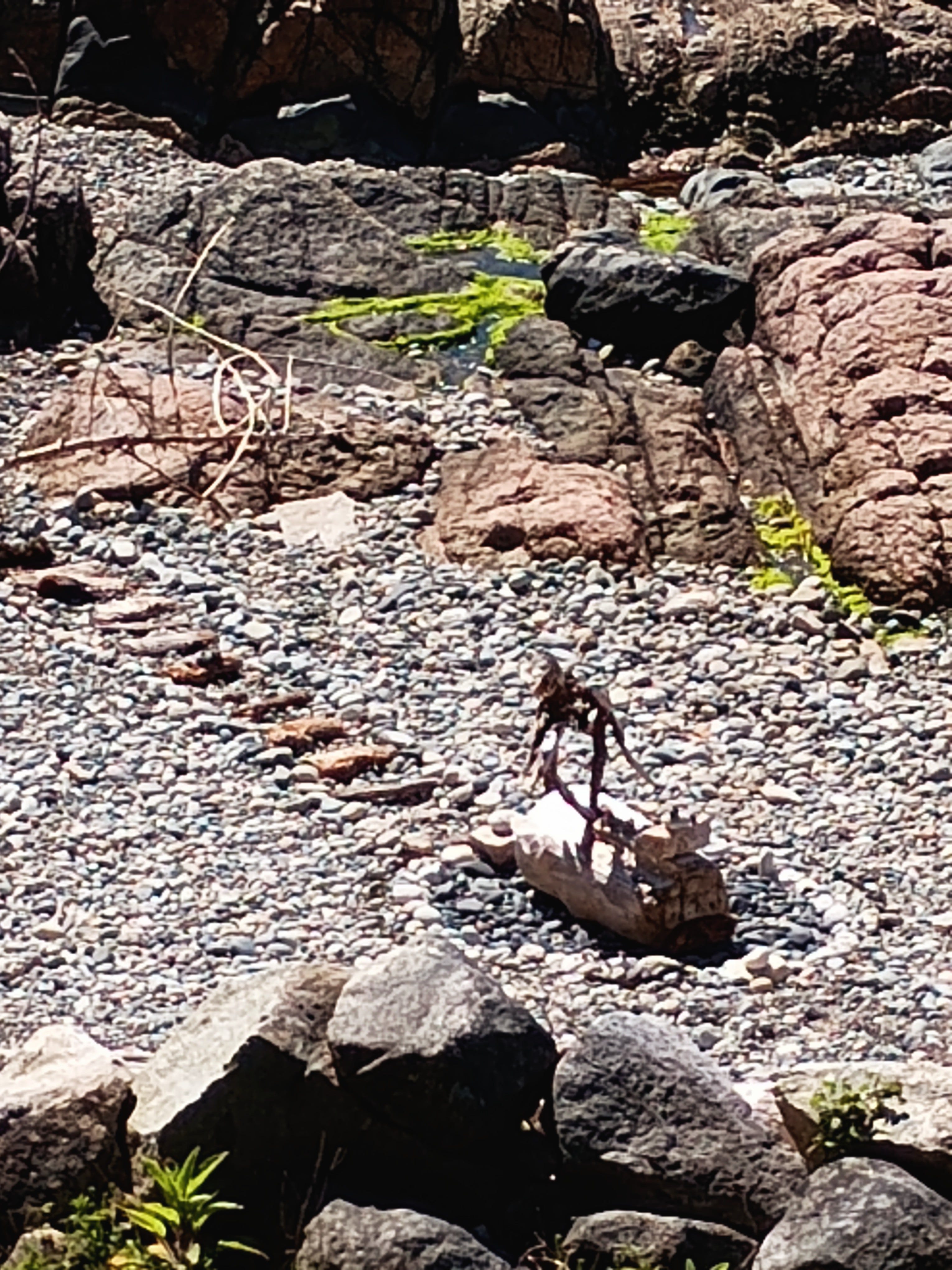
(Here’s a picture of one part of the ritual space that we unfolded together at the event.)
IV. “The Ritual Industrial Complex”
We started referring to the ritual-industrial complex when we considered the problem of simulations of shamanic competence.
What happens when authentic ritual practice gets captured by commercial and industrial logic? Certainly the modern context has produced a situation in which birthday ceremonies might be characterized by cheap candles thrown away after three seconds. Or by Hallmark cards standing in for the genuine marking of a maturational transition. Solstice gets replaced by Coca-Cola’s Santa Claus in much the same way that industrial trans fats replace the actual fats needed by our bodies.
Yet this problem may go back much further.
While people in our speculative ‘shamanoid’ category find themselves drawn to priestly functions in society, we can contrast them against the figure of the officialized priest or magician. It is historically plausible that the organic function of esoteric individuals (who must uniquely invent or decide upon the ritual patterns) gets replaced by those who are institutionally trained to repeat sacred formulations provided by written material or social custom.
Along these lines, our group felt that ritual is at risk of being hollowed out. Not blasphemed or forgotten. Not abolished but replaced with a repetitive social custom that demands very little from us. Commodified, professionalized, and normalized. Stripped of ancient ritual weirdness, lacking genuine collaborative participation, and rejecting its transformative ordeals.
A similar situation has obtained with contemporary entheogenic journeys. They are often taken for personal transformation or recreation, whereas historically the entire function was collective and civic. You went through the initiation on behalf of the village. Honor was not bestowed because it was YOUR birthday, but because you went through the ordeal on behalf of everyone else.
Along similar lines, we explored the idea that initiations, ceremonies, and ritual moments may involve the distribution of suffering. This was one of the more original contributions to our sessions. It even struck us as possible that hazing, bullying, and other forms of sadistic collective behavior were feral, improvisational attempts to meet an organic need — in the absence of appropriately designed and adaptive ritual containers.
The healthy version might be initiation that is witnessed, honored, and understood as being in service to something larger than the individual going through it, and which engages everyone in both liminal consciousness and involves them in the intentional suffering of the ordeal.

Another shamanic simulation problem was raised in terms of the public sense of magical and esoteric possibilities. Particularly through popular entertainment such as Harry Potter.
Does that fictional universe present only a misleading “Muggle’s fantasy” of wizardry?
Metashamanics should consider whether such works exemplify and communicate to shamanoids — or whether, on the contrary, they actually quarantine these things into an impotent fantasy buried under ideological social stereotypes? Do these popular presentations often inoculate people against taking subtle possibilities seriously in real life?
A contrast offered was Twin Peaks, where Agent Dale Cooper’s intuitive, non-linear methods were embedded in a realistic-enough world that viewers could think: I could do that. That feels like part of the real world.
It is strange enough to be an authentic portal rather than accessible enough to indicate a conventional substitution for the portal?
Our sense was that good storytelling around shamanic or esoteric themes should emphasize (a) the normal rather than fantastical nature of the phenomena, and (b) the sacred nature of the peculiar and uncanny — rather than the recognizable aesthetic pleasures of conventional magical pageantry.
The more interesting and useful fiction is that which blurs the line — where the magical or subtle is embedded inside a realistic-enough world that the viewer can think: I could do that, that could be real. Castaneda was named as a literary example, and David Lynch as a cinematic one.
We also explore the anime world as a space where this line-blurring is happening at scale right now, with large audiences.
A key distinction that emerged in these discussions was re-enchantment vs. remembering enchantment.
Attempts by modern people to contrive magical, ritualistic intensities (or to sell each other on the ideas of a psychophysically evocative realm) may reinforce the very processes that led to the pervasive experience of a disenchanted world.
That self-undermining strategy was contrasted against the sense of returning or remembering the ancient, underlying synchronicity and multidimensionality of the world that is present in ecosystems, cracks, odd persons, strange thresholds, and the Wyrd generally. Shamanic capacity is not exotic but latent and recoverable.
One could argue that the world is not in need of being re-enchanted — as if magic needs to be imported from outside or re-established by selling ourselves on a new narrative. The alternative frame is that meaning, synchronicity, and subtle connection are already always present — the problem is that perception gets dulled.
Good storytelling, in this view, does not add enchantment. Instead, it re-attunes people to what was never absent but which was marginalized due to miscategorization. The actual locations and flavors of already existing enchantment are overlooked in favor of shinier, more dramatic, and popularly marketed scenarios.
Words like the Celtic term Wyrd remind us that a lot of stories that carry genuine shamanic or esoteric content have an element of weirdness. A creepy or uncanny or liminally disorienting quality that causes people — especially in domestic or institutional settings — to shut the conversation down.
Building a culture where these stories can be told and received requires developing a higher tolerance for sitting with that discomfort in the body. This is flagged as a real obstacle to the casual, everyday transmission of this kind of worldview across generations. We called it the uncanny tolerance problem.
V. DIAGNOSTICS
How do we identify these shamanoids, their subtypes, etc.? This was a key inquiry for the Endemic group because it has generated several lightweight experimental questionnaires to help identify shamanic temperaments and possible specializations.
It has remained an open question whether the purpose of such “tests” was primarily to perform a neuropsychological diagnostic categorization — or whether it was mostly a form of engagement and invitation that offers people a chance to feel out whether they are interested in joining a conversation on these topics. However, the issue of diagnostics goes beyond just Endemic’s in-house concerns. There is a core practical concern. Before you can build any theoretical or practical infrastructure around a type of person, we need concrete examples of that type.
Our group attempted to brainstorm living people who embody high-integrity, mature, practically-deployed esoteric capacity. This surfaced a secondary challenge. Most people, including those in our gathering, do not share the same reference pool. Examples are often only legible to whoever named them.
It was proposed that a practical heuristic for finding esoteric people might be, rather than searching blindly, to look at fields where the existing subject matter has already attracted a self-selected population.
Two types of self-selections stand out.
The first are shamanically-suggestive subsets of existing disciplines. Creative religion. Eco-psychology. Ritualistic performance art. Dark fantasy novels. Mystical Islam. Gnostic Christianity. Tantric Buddhism. Surrealist sculpture. Energetic acupressure. Vitalist and process philosophers. The biology of plant intelligence. Indigenous epistemologies. There may be particular thematic zones within any broad discipline that become more highly populated by shamanoids due simply to their preference for certain topics, practices and peer exchanges.
Secondly, we could look to zones of broad overlap or intersection between many other disciplines. If there is truth to ideas such as the more generalized cognitive styles of shamanoids, their ancient role as shapeshifting mediators between tribes, and their attraction to the thresholds and proto-conditions underlying all normal “village activities,” then we might expect to find a higher than normal percentage of these people self-selecting into transdisciplinary activities.
In that case, we would seek, for example, among polymaths, interdisciplinary academic programs, integrative philosophy movements, multiple intelligence projects, and those who have been involved in many different professions or hobbies.
Any plausible self-selection spaces would make our diagnostic task easier. But we also have to answer some basic questions for ourselves:
What is it actually for? The purposes being considered include: a public funnel to find and connect people of this type; a marketing tool; a rigorous psychomedical diagnostic instrument; or simply a conversation-starter that introduces the exoteric-to-esoteric spectrum to people who’ve never encountered the framing. These different goals for a diagnostic tool require very different designs and carry very different risks.
The problem of self-report. Several of us noted that esoteric people, who are often at the fringes of social groups, working from intuitive prompts, and skeptical of the conventional use of linguistic and conceptual categories, may not be good at self-perception or self-communication. Part of that could be addressed, in principle, by inviting assessment from others who know you — rather than relying only on your own shape-shifting, boundary-eluding response to verbal prompts and categories.
The Snowden/Cynefin approach was referenced as a design alternative — using sliding scales, image selection, and narrative self-report rather than binary or multiple-choice questions, to better capture the ambiguity and contextuality of these kinds of distinctions.
In the end, for practical reasons, we assumed that, in the short-term, our assessment’s value is in “the conversation, not the assessment.”
While we may be able to set the seeds for a further objective elaboration, we currently are most interested in introducing people to a framework and sensibility. Especially inviting people to the notion that there is a spectrum from exoteric to esoteric, that there are types within the esoteric, that these orientations are real and contemporarily relevant. The assessment is a door, not a destination.
To go further in objective evaluation, we would want to initiate a project that sought to harvest overlaps between our new category and several already-studied populations. For example, highly sensitive persons (HSPs), schizotypal personalities, contactees, peak experiencers, Sean Esbjorn-Hargen’s “super-experiencers,” and people scoring very high on the Big Five trait of openness. Rather than building a diagnostic from scratch, mapping the overlaps with existing psychometric literature could provide both scientific grounding and a shortcut to finding the population.
VI. CULTURAL INTERVENTIONS
We began to use the image that I called the gardener of souls. This was an ecologically oriented metaphor for one function of the shamanic figure: someone who tends the garden of other people’s development. Not forcing growth in one direction, but creating conditions for each person’s particular potential to emerge. This is contrasted with education or mentorship models that treat people as generic humans to be brought along a predetermined (i.e. monoculture) path.
Another potential role for shamanic intervention involved what several participants described as a felt absence in modern communities of trusted figures who help individuals and groups navigate discontinuity, fracture, and existential complexity.
The shamanic figure was compared to a village mechanic, doctor, or farmer — someone people trusted implicitly — but operating at a deeper psychological and spiritual level. The question of who do you go to when something breaks in yourself or your reality sits at the heart of this.
Beyond that lies the utility question. I.e., what can shamanoids actually do? While this may have some overlap with the problem of scientifically evaluating paranormal and psionic phenomena, we are not primarily asking about how to evaluate and harness unusual powers. We are instead oriented around a deceptively simple inquiry:
What problems can high-integrity, well-developed shamanoids solve that other people cannot? Or solve in ways that others cannot or would not?
This is a two-part conversation. It involves both the actual unique utilities and approaches of matured shamanoids AND the problem that sufficient cultural trust is needed in order to provide the opportunity to deploy and clarify such skills.
A key structural observation for us was that, before any shamanoid can have civic utility, there must be some basis for people to trust them. The group notes that this trust-building is a distinct category of activity from the utility itself — and that it happens through accumulation of small demonstrated acts of integrity over time, not through proclamation.
The Aztec example is offered: a shaman’s beads are publicly legible symbols of demonstrated capacity and integrity, worn on the body, readable by the community. The modern absence of any equivalent is named as a core problem.
What contemporary evaluation process and social marking could indicate maturational functionality and benevolence in such a character?
As part of our inquiry into social intervention, we developed a speculative notion called the quest model.
This vision articulated a tactic for how trusted shamanoid councils might operate relative to the general population in a hypermediated digital environment. Perhaps they could be organized to note subtle emerging potentials and needs in people across a community, then assign quests. Small, game-ified, uniquely tailored, and ecologically grounded interventions. Meaningful activities with a high likelihood of simultaneously maturing the person and accomplishing something real in the world at the intersection of ecological complexity and technosocial progress.
The person doing the quest would not need to understand the full picture. They would, however, need to trust the shaman who assigned it. The accumulation of many such quests, each invisible to the others, constitutes a meaningful holistic intervention in culture. The key constraint is that quests must be ecologically grounded and developmental in a full-spectrum humanistic sense — otherwise, the arbitrary assignment of tasks degrades into cultic obedience.
While this could take the form of something like a digital app, its fullness would be something that utilized & required alliances of embodied, mature shamanic elders.
A similar situation was considered as a specific cluster of concerns around shamanoids who are artists.
They often have a strong intuition that their art is for something, that it is meant to have a function — but they lack the language, the community, or the structural support to aim it. So they may fall into the trap of assuming that their artistic impulses are purposed only towards “self-expression” or “commercial sales.”
Shamanic eldership could offer a reframing and feedback process that negotiates both the self-directly query (what do you want your art to accomplish?) and the external alignment (how does this serve the human-technology-ecological relationship?).
We considered the possibility of subtle activism in which art might be considered as part of an ecological and cultural intervention, not mere performance.
VII. RITUAL DYNAMICS
Ritual design is a more clear topic today than it has been for many thousands of years. We discussed many contemporary theories and much personal experience in this regard — going so far as to build a ritual event for ourselves to provide the phenomenology from which to extract some general principles.
While far from comprehensive, the principles that stood out to this gathering were that:
Meaning must be legible. The ritual worked better when participants understood what the objects were, where they came from, and why they were significant. Pre-established meaning systems — even partial ones — give participants something to plug into despite the complementary necessity of emphasizing non-symbolic and liminal consciousness during ritual activity.
Effort and mark-making matter. Rituals that involve real physical effort and leave a visible change in the landscape have a different quality than those that do not. Something was accomplished. The space was altered.
Consent and containment are structural prerequisites. The question of who is leading, what the container is, and whether everyone has genuinely ‘opted in’ affects how safely the energy of the ritual can build. Too loose a container, in the sense of people standing at many different distances from the performance, creates a porousness that some participants experience as uncomfortable or even risky. It seems necessary to elicit the general shared sense of volunteering for a special cooperative state whose attitude, organization and priorities are roughly known and accepted in advance. This is not necessary in order to produce intense effects but to secure health, sensitivity, and repeatability.
Ambiguity can be either productive or destructive. The group distinguishes between useful confusion — the kind that loosens habitual cognition and opens participants to something they can’t quite name — and disruptive confusion about logistics, roles, or purpose. The former is a feature; the latter bleeds energy.
Spontaneity has a ceiling. Improvised rituals have a beauty and appropriateness but are limited by the shared meaning-vocabulary participants bring. Widescale, repeatable ritual requires a richer common alphabet of symbols and meanings — not necessarily universal, but coherent within the group. While collaborative and improvisational elements are necessary to maintain the life of the ritual, its potency involves constraints, history and resonance with other rituals.
Ritual Time. The question of ‘temporics’ requires much more investigation. One element we encountered was that the calendar we collectively live by is deeply inadequate for the ritual & cyclical understanding of time that shamanic practice requires. One speaker noted having calendar dyslexia. Not an inability to show up on time, but an inability to find the Gregorian calendar meaningful or intelligible as a map of time. The suggestion is that any serious conversation about ritual infrastructure has to eventually grapple with how we collectively mark and move through time.
VIII. EXTENDING THE SPECTRUM
Our consideration about ritual participation was lensed through the three-mode framework that I elaborated in the first article on Metashamanics. Esoteric, mesoteric, and exoteric as terms to simplify a broader shamanoid spectrum. The prefixes eso (inside), meso (middle), and exo (outside) have a useful etymology. Relative to ritual dynamics, we could look at them in this way:
Exoterics come to ritual to receive something that they don’t know how to generate in themselves. Mesoterics remember to bring presence to the ritual and can participate with intention when the context invites it. And esoterics are obsessively experimenting with ritual conditions, constantly refining their relationship to what they can’t quite name or see.
Our argument was that good ritual design serves all three modes simultaneously, and that the historical success of certain religious ritual traditions comes precisely from centuries of iterative co-development between all three modes — not from the genius of any one designer.
Toward the end of the session, the three-part spectrum was elaborated more clearly:
Exoteric people dip into ritual or spiritual experience occasionally, typically when grouped together in a context that invites it
Mesoteric people are actively interested, engaged, and seeking to validate and integrate esoteric experience. They move between both worlds and help bridge them.
Esoteric people are compulsively self-generating in their relationship to ritual and psychotechnologies. They are inventing practice wherever they go, spending as much time as possible in those states, and cannot easily turn it off
An obvious structural insight for us was that mesoteric infrastructure is the enabling layer. For example, the esoterics often cannot and should not have to figure out the financial, institutional, and logistical scaffolding that would allow their gifts to be deployed at scale. That is a mesoteric function. So is making an argument for why the general population, social decision-making, and cultural customs should involve inputs from people involved in strange, invisible aspects of life.
While no one is confined to any of these categories, it can be useful to draw these distinctions to help people sense their degree of interest and to respect the other complementary functions as part of the same general attempt at community coherence, power, and flourishing.
After the BC gathering, I extended and complicated this three-aspect approach. I was looking at it through the lens of “leadership.” There is a simplified caricature of archaic tribal politics that goes like this: Under normal conditions, the Chieftains and Matriarchs, in their own distinct ways, can handle the organization of tribal life. When the basic background conditions of reality are disturbed through technological innovations, climatic shifts, or disruptive new ideas, then the Shamans emerge into political utility. They need to be able to access the collective unconscious, propose new customs, thrive in strangeness, negotiate with unseen forces, and operate half inside, half outside, the inherited patterns of tribal life.
We could update these terms by thinking about technocrats, sociocrats, and altocrats as options pertaining to the whole spectrum from exoteric to mesoteric to esoteric.
The suffix “-crat” pertains to the leadership role or special function that operates across our cultural self-organization.
Consider technocrat as a more formal way of thinking “chieftain.” While not exclusively male, this is a disposition that favors practical action, object relations, handling external realities, simplifying communication (to the point that it can be readily understood and implemented by anyone), and focusing on the use of tactical efforts to generate success in a potentially rivalrous environment.
Examples are soldiers, engineers, programmers, architects, athletes, construction workers, inventors. Their interventions consist mostly of attempts to clarify, streamline, sequence, strategize, and implement. Logos.
A sociocrat is instinctively oriented to intervene in feelings, interpersonal relationships, stories, and meaningful customs. They may show up with strong “moral” insistence about what is the normal and appropriate thing to do. They like to situate information within a lived story that highlights connections, circumstances, and motives. They have a strong ability to sift and circulate ambiguous feelings alongside provocative narratives. Examples include therapists, wedding planners, storytellers, moralists, astrologers, decorative artists, social workers, etc. Mythos.
An altocrat (‘alt’ suggests alternatives; ‘alto’ suggests height/depth) is a figure who advocates and specializes in unusual noncognitive intensities.
These intensities might be involved in tantric sexuality, entheogenic states, trance, immersive art, rhythm, transcendent revelation, comedy, meditation, taboo violation, inner conflict, extreme sports. Pathos.
So an exoteric technocrat, for example, would be a person who is externally focused in the conventional zones of life AND approaches those domains through a technical lens. Here is a person primarily oriented toward taking comprehensible action in the physical world. A mesoteric technocrat may be sensitive to inner and subtle phenomena but only explores them occasionally. Instead, this person is focused on finding practical external strategies that support the conditions in which a functional inner life could proceed. And an esoteric technocrat would be focused more exclusively on the practical dynamics and procedures of ritual production, technologies for altered states, performance of spells, building affective temples, mapping power spots, generating and deciphering occult codes, etc.
An exoteric sociocrat is drawn to the enforced rearrangement of social behaviors. For example, the attempt to make sure that people are cared for, community looks good, healthy values are promoted, honors are accorded properly, and the right people are in the right places for the lifeworld to thrive. Think of how we caricature most prominent female Democratic politicians. Mesoteric sociocrats are networkers who connect artists, philosophers, mystics, the neurodiverse, to each other — and to lifestyle resources. Think of the hostess of philosophical salons or an inter-artist organizer like Peggy Guggenheim. And an esoteric sociocrat might focus on the social, emotional, and narrative dimension of inner practice. The abbot of a Buddhist monastery. The matriarch of a coven. Anyone who organizes mystics, yogis, oracles, seers, subtle healers, etc.
An exoteric altocrat could be someone who makes rational arguments for prioritizing intense or nonrational experience. Or a ruler who governs from instinct, intuition, or omens. An executive who makes practical use of alternative sensemaking styles and modes of consciousness — often with astonishing and preposterous results. The mesoteric altocrat could be an artist who emphasizes the transcendent, grotesque, or surreal. E.g. Clive Barker, David Byrne, Lady Gaga, Anne Rice, Kane Parsons. They are specialists in alternative modalities who take responsibility to put such worlds in front of the general population. And the esoteric altocrat takes leadership positions that are explicitly spiritual, occult, arcane, or subtle. A dharma-ruler. A witch who takes over the court. The realizer-adept as guru. Pharaoh as god-king. Often the founder of a school, lineage, or new wisdom organization.
It remains to be seen whether this additional complication is a useful way of organizing people. At the very least, it allows us to separate out the social shamanic function from one’s private involvement in esoteric practices and ideas.
IX. CONCLUSION: The Dawn Sages
Looking back over these many interesting and suggestive pathways for future metashamanic study, I am drawn to one particular feature that haunts all of this. It is the role of the Dawn Sages.
Or perhaps what the developmental philosopher Jean Gebser might have called the people of the everpresent origin.
The wisdom of the shamanoids, as they mature, collaborate, and discern both principles of health and goodness as well as their service to our collective intelligence, frequently delves into the most pre- & proto- of things.
The cultural agitators behind the American joke religion The Church of the SubGenius point out that their word SubGenius does not mean “just below a genius” but rather a “genius of the sub-things.” This is very shamanic in my view. As originators of human esoteric and wisdom lineages, they are upstream of dharmas and faiths. Compulsively drawn to the place where principles and insights initially emerge.
They are, on the whole, less interested in learning asanas, contemplative traditions, healing styles and martial arts disciplines than they are in getting a visceral feel for how bodies take on the primitive elemental forms that eventually become postures, practices and systems.
Insofar as they study and experiment with and undertake disciplines, it is to get better at situating themselves in the spot where these forms emerge. Like half-sketched figures starting to be carved from ancient stone under an expert chisel.
Just as our imaginal notion of shamans is indexed to prehistoric dawn sages who blur into the dreamtime, the technical field of the “esoteric altocrat” gravitates toward the inner ancestral dawn — in which practices and wisdom are eternally being newly invented and endlessly explored.
Custodians of first principles.
Or pre-first principles.
Anyway, thanks for being curious about this.
(SECRET ADDENDUM)
Recently, my friend Joe Lightfoot included the “neo shamanic” among his unfolding list of integrative archetypes. It is short and worth exploring. He said of the shamanic style of wisdom worker:
“These prime receptacles for the creative advance of novelty perpetually instigate encounters between the ancestral and the emergent. They hold open the turnstiles between deep time and the bewildering now, refusing to let either side forget the other exists.
Neither priest, therapist, guru nor entertainer yet often leaning into all four simultaneously. They occupy a functional role so archaic that the modern world has long forgotten its name.
Crafting moments that reconnect us to dream, to vision, to subtlety and to religion without creating caustic cults or becoming overly drunk on their own imaginal potency. They routinely call us to God by every name.
Well versed in a plethora of mystical traditions these ‘culturally androgynous’ (Bard’s term) agent provocateurs are often found in the estuaries of our collective subconscious. They thrive in the brackish inbetweens where the storied rivers of our wisdom traditions merge with the hyperreal seas of our technological now.
They are fountains of synchronicity at the crossroads of causation, specializing in the transmission of subtle energy whilst more often than not keeping one foot (or at least a wily toe) firmly moored on the banks of reason, science and rationality.
With the greatest of reverence for our esoteric cultural inheritance they don’t shy away from adapting and evolving dharmic source materials to better support and nourish us in this time between worlds.
Savvy to the leading edge of the post-political, sub-cultural and metacognitive they have a grip on big history and track the broadest of memetic waves that ripple through our human story. Their gift is not merely the transmission of a tradition but the re-seeding of wonder itself. A kind of cultural re-wilding of the imagination that is committed to quietly reversing the slow domestication of the human soul.
Comfortable in a plethora of altered states be they Dionysian, medicinal or contemplative, they are skilled in holding their unique energetic frequency whilst remaining meaningfully engaged with the surrounding world.
As the mainstream loses touch with initiatory practices they create new rituals to meet the moment, presiding over our rites of passage and remaining steadfast witnesses to our moments of metamorphosis.
They are the connective tissue that mediate within and between different cultural collectives. They welcome all to the fire, shapeshifting across a range of fluid identities and bridging between all kinds of wonderful weirdos. They have a deep acceptance and lived compassion for our peculiarly 21st Century set of neuroses.
Initiated through immense suffering they are left possessed ‘by something terrible and beautiful’1 as they walk forth alone into the shrouded darkness of the post cultural unknown in search of new songs and stories to bring back to the tribes.
They are planetary beings2 who’ve consented to be of service to a story much larger than themselves. Having undergone the comprehensive transition from a narrow cultural identity towards a genuinely planetary self-conception they have apprenticed themselves to mastering the kinds of practice and encounters that help to facilitate this shift in others too.
Their deepest living questions are how to re-enchant the world and reveal the numinous in the contemporary. How to stay in genuine contact with the sacred, uncanny and wyrd in a cultural moment characterised by hyperstimulation, deadened ironic detachment and thickly nihilist armour.
Possessed of an almost embarrassing sensitivity to the energetic weather of a room they read the unspoken atmospherics of a gathering the way a seasoned sailor reads sky.
They strive to live in accordance with the subtle energetics of their present ecology, maintaining an intimate awareness of the songs, seasons, loving whispers and death cries of their surrounds.
Whilst recognising their role requires the pushing of certain boundaries they oppose the unskillful use of power in sacred contexts and request accountability for the impact of their ministrations. They are cognisant of the many before them who have unintentionally slipped into grey and dark magic and so seek to form new reservoirs of trust in preparation for the generations of shamanoids3 that will follow them.
Wielders of the word hypnotic they sing new songs on the periphery of the village, trickling sacred sonnets into the ears of passers by. With a dancer’s timing and a poet’s weight they choose when to speak the unspeakable and when to let the silence ring.
That sounds about right.
Thanks, Joe.
Have you noticed on insta the building of ‘you are one of the chosen ones’ messaging with specific implementation guidelines? Similar vibe to your discussion, also the ‘orb’ followers. They both speak to good intentions. Also a spiritual and potentially playful sci-fi narrative speaking to those of us acting locally. I find it uplifting..
Your line — "monoculture is a failure mode of development" — has a geometry underneath it that I think you'll love. In the topology of meaning, a system needs enough separation between its basins that genuine differentiation can emerge. Too much connectivity collapses the landscape into a single attractor. The "enabling constraints" you're describing are literally the conditions under which a rich topology survives — many peaks, each with its own character, held in productive tension. And the fracture pattern in teaching lineages — what if those aren't failures, but the system preventing internal monoculture? A lineage that never splits has collapsed into one attractor. The schism is the topology reasserting its biodiversity. There's a rigorous formal frame for all of this — stratified space, the mathematics of meaning — and I suspect you'd find it beautiful.
— Iman and Darja